Housewives, mothers, daughters, peasants, minor roles of leadership, etc., -- that’s what women were considered during the time of the Middle Ages. In today’s society, gender equality plays a tremendous role. Women are just as equal as men, and are just as qualified and superior as men in today’s world. However, during the Middle Ages, women were considered the total opposite of what they are today. Women were nothing but inferior to men. There was no gender equality during that time period, which meant that leadership through a woman was extremely rare. With that being said, a female was not capable to any opinion regarding leadership or political matters.
Throughout the Middle Ages, women of the lower-class were bakers, brewers, artisans, weavers, and mainly farmers who worked alongside their husbands and children in fields. During that time, the land that the female tenants and their families worked at, were owned by the lord-- who was the one to decide who a girl would marry, as she was the property of a serf more than her father and mother's. Women throughout this time were only expected to stay at home. They were considered as nothing but housewives, the women to take care of their husbands and family.
During the Medieval times, it was difficult for ladies to advance in life as it was an issue for them to demonstrate a spot for themselves as they were not permitted and had many restrictions put on them; therefore, that meant that what they were naturally introduced to was what they were to portray themselves as for the rest of their lives. In any case, as cultural changes flourished throughout time, these desires and jobs set upon ladies started to develop and change all through the Renaissance and into the nineteenth century. Despite the fact that, these jobs were not totally pulverized and out of date, ladies were capable of taking a step forward into something they desired. Through the Medieval times and onto the nineteenth century, ladies are appeared all through numerous artworks transcending the cultural standards and doing everything they can to get away from business as usual.
Through the course, context such as Whitney Chadwick's has displayed an immense illustration for gender roles regarding women. As time went on, the roles of women began to develop further into more superior roles. Women were now able to fulfill their dreams of getting an education or furthering onto a career, although it was not something common or something that was to make men inferior. In Women, Art, and Society Chadwick quotes, "I do not permit a women to be a teacher, nor must a woman domineer over a man; she should be quiet," referencing that women were not able to make men inferior with whatever they were to do (Chadwick 45). Women were to always be inferior to men.
 |
| Judith Leyster, The Proposition, 1631 |
Regardless of the fact that times were changing, and women were being allowed to progress a bit more in life, they still were not treated well. They were treated as if they were not human beings, but woman that were born to provide care for everyone. In The Guerilla Girls, the author states that women were to be married by the age of 15 with or without consent, that they were inferior to men and that abuse was acceptable if they went against their husband's wishes/demands, and that "education was thought to interfere with a woman’s ability to be a good wife and mother” (The Guerilla Girls 22). Through that text, it is quite evident that women were portrayed as nothing but housewives. They were to do nothing but slave for their family. They were to push aside their happiness and career plans (if they were to have any) and make sure their family was happy and being taken care of.
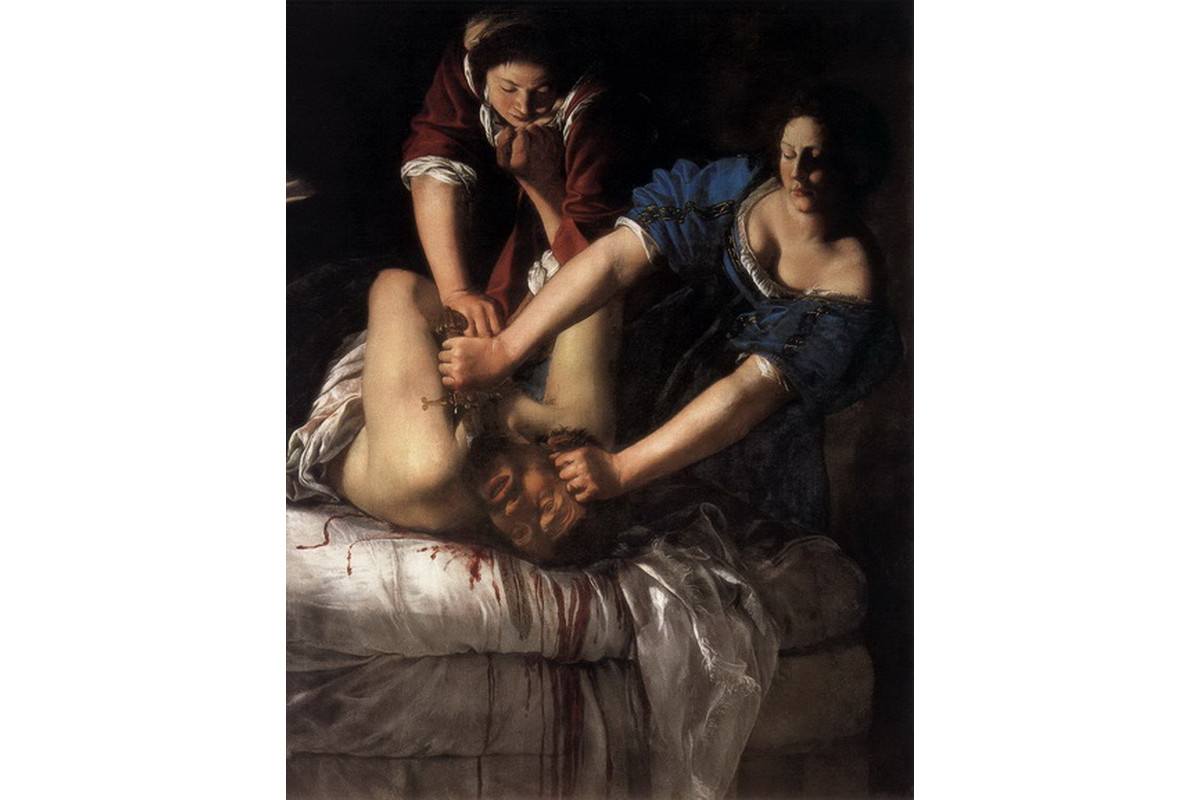 |
| Artemisia Gentileschi, Judith Slaying Holofernes, 1618 |
An impactful painting, in my opinion, is this one on the right by Artemisia Gentileschi. A strong painting by him was the one and only Judith Slaying Holofernes. During the time of the Middle Ages, women were incapable of holding a stand for themselves. They were not able to be anywhere near equal to men nor were they able to portray themselves as an individual. Whether it was marriage, rape, abuse... women had to tolerate everything without creating a scene or taking a stand for themselves. However, in Gentileschi's painting, the author displays two women slaying a male figure brutally. With that being said, it is often interpreted as a painted revenge for the rape. This art work of mirrors a huge representative quality and is seen as a spearheading visual discourse on systematized sexism and desire for women's' privileges.
Similar to Gentileschi's art of Judith Slaying Holofernes, Judith and her Maidservant was just as impactful. In the art, it is displayed, Judith with her maidservant holding a basket severed head of Holofernes. An artwork like this depicts and displays nothing but superiority of a woman. No one would expect a woman to take upon such a harsh act like murder or beheading someone, up until Judith. This art shows nothing but the independence and violence a woman can display just as equally as men. This was a start to pushing gender roles aside and showing that women were capable of standing for themselves. Additionally, woman did not want to be simple housewives and do everything based off others needs. They wanted to be an independent woman and have something that labeled them as themselves; not as someone's wife, or someone's daughter or someone's mother.
 |
| Artemisia Gentileschi, Judith and her Maidservant, 1618 |
Work Citied:
Chadwick, Whitney. Women, Art, and Society. Thames & Hudson, 2012.
Girls, Guerrilla. The Guerrilla Girls Bedside Companion to the History of Western Art. Penguin Books, 2006.

No comments:
Post a Comment