Brittany Zota
Professor Caçoilo
Post 2
27 February 2020
Women have always deemed to be below men in the hierarchy status regardless of how wealthy they are. Women also have been faced with double-standards from the beginning of time solely due to their gender. In the Middle Ages, females in Europe had certain roles to obey including, fulfilling their duties as either daughters, wives, mothers, or nuns. More likely than not, women were forbidden to follow their passions and were expected to assist their husbands in any way shape or form that was demanded. Religion also played a major role in this era because of women who were not married off and were taught how to perform crafts and dedicate their time to worshipping God instead. Sadly, women were viewed as housewives who did all the chores to ease the stress on the superior gender of mankind. Since females had little to no rights, they went to church to receive some education and find means to express themselves through art.
 |
St Angela Merici (1474-1540)
|
 |
| Elisabetta Sirani: Portia Wounding Her Thigh, 1664 |
 |
| Rosa Bonheur: The Horse Fair, 1853 |
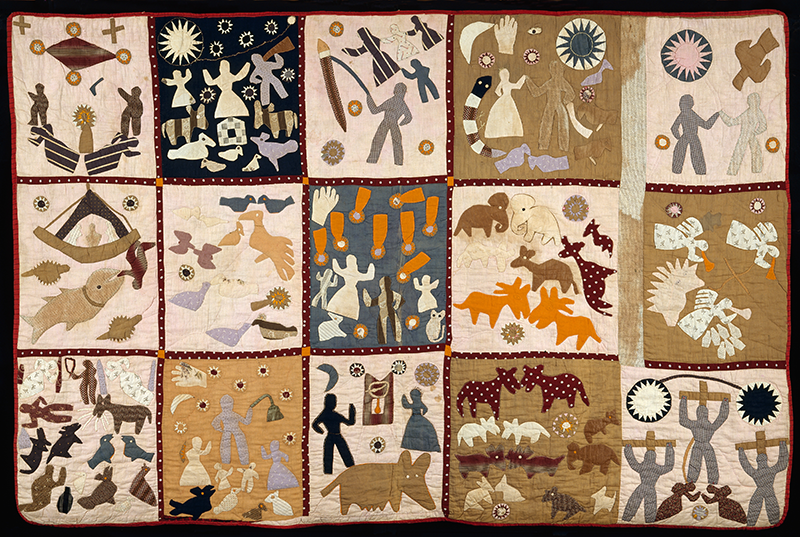 |
| Harriet Power's Bible Quilt, 1886 |
The roles of women began to slowly change in the Renassaince era, and therefore female artists began to share their work with the society a bit more, as shown here Women in the Renaissance, but very subtly and definitely no on a large scale. Though women were still inferior to men, women in different classes had different roles. Low-class women were expected to be housewives. The working-class women were expected to work for their husbands and help them run their business. They would work alongside their husbands and then go home to take care of the household. Upper-class women may have had servants but were still expected to do housewive-like chores as well. However, they had more time for their hobbies, as Chadwick said: "“The upper class where the spread of Renaissance ideas about the desirability of education opened new possibilities for women” (Chadwick 76). Women could not work by themselves. Neither could they live alone if they were not married. If a woman was single, she was made to move in with one of her male relatives or join a convent and become a nun. There was no other option at this time for women. Chadwick writes, “Most of the highly skilled artisans were now men; women were relegated to areas that required fewer skills, or skills of a kind that could be easily transferred to new households upon marriage” (Chadwick 68). During this time, females were challenged by not being allowed to paint pictures of men perhaps in case they were to misrepresent their patriarchy. "The whole system, was, of course, closed to women. In most cities, women were barred from painters' guilds or academics, most were illiterate. One of the few ways a woman could work as an artist was to be born into a family of artists that needed assistance in the family workshop" (Guerrilla Girls 29). Ridiculous accusations were claimed towards women painters who were successful, such as Sirani, who was accused of signing her father's paintings. To prove the community she lived in wrong, Sirani began to publicly paint.
As the 19th century came around, women's presence in the art world became more prevalent. They still had many limitations and rules to follow, but slowly their work was evolving and surfacing publicly. Many female painters from the nineteenth century are now well-known for their rebellious acts: 9 Trailblazing Female Painters of the 19th Century You Really Should Know About. To begin, Rosa Bonheur, made a fortune selling her work and spreading advice to other females stating, "let women establish their claims by great and good works and not by conventions" (Guerrilla Girls 49). Another well-known artist for her time, Harriet Powers, who was born into slavery around the 1830s, sewed a quilt representing biblical stories and folktales, which she later sold to an art teacher at a local fair. Therefore, one can see how women slowly but surely, eventually found their way into the artistic world. Even though females have struggled for centuries to gain equal rights, respect, and opportunity as men (while some may argue that society today has mastered this idea), women today are still fighting the same fight. Whether women are rebelling to get recognition for their artwork, or being seen as equal talents for their creations, in the end, a similar situation is to this day present in our community. Why is it that females can visually create something just as or even more intricate, meaningful, and beautiful as a male, but when you go to a museum there are far way too many male artists on display compared to women.
As the 19th century came around, women's presence in the art world became more prevalent. They still had many limitations and rules to follow, but slowly their work was evolving and surfacing publicly. Many female painters from the nineteenth century are now well-known for their rebellious acts: 9 Trailblazing Female Painters of the 19th Century You Really Should Know About. To begin, Rosa Bonheur, made a fortune selling her work and spreading advice to other females stating, "let women establish their claims by great and good works and not by conventions" (Guerrilla Girls 49). Another well-known artist for her time, Harriet Powers, who was born into slavery around the 1830s, sewed a quilt representing biblical stories and folktales, which she later sold to an art teacher at a local fair. Therefore, one can see how women slowly but surely, eventually found their way into the artistic world. Even though females have struggled for centuries to gain equal rights, respect, and opportunity as men (while some may argue that society today has mastered this idea), women today are still fighting the same fight. Whether women are rebelling to get recognition for their artwork, or being seen as equal talents for their creations, in the end, a similar situation is to this day present in our community. Why is it that females can visually create something just as or even more intricate, meaningful, and beautiful as a male, but when you go to a museum there are far way too many male artists on display compared to women.
Work Cited
Chadwick, Whitney. Women, Art, And Society. Thames & Hudson, 2007.
Gender Roles of Women in the Renaissance.
The Guerrilla Girls Bedside Companion to the History of Western Art. Penguin Books, 2006.

No comments:
Post a Comment