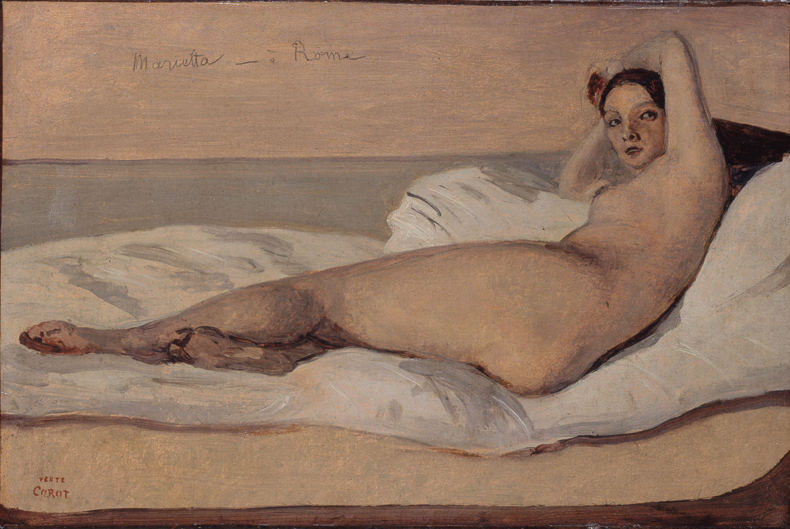
The male gaze as described by John Berger is the notion that women exist for the gratification of man. The way he explains it is that men act and women appear, “the surveyor of woman in herself is male: the surveyed female. Thus she turns herself into an object- and most particularly an object of vision: a sight” (Berger 47). Not only are women becoming a sight for pleasure, but also a way for men to distress. ““Men of state, of business, discussed under paintings like this. When one of them felt he had been outwitted, he looked up for consolation. What he saw reminded him that he was a man” (57). The male gaze is so pervasive in art and popular culture that it still governs the consciousness of many women. In a way, they do to themselves what men do to them. These ideologies have served a demographic and challenging that establishment is not the instinct for everyone. On the contrary, in more contemporary times, we have seen the roles of women in movies become overtly oversexualized, and we notice that they are directed by men. In comparison, movies that are directed by women give the female characters a sense of power and independence we are not offered by other films.
The very first sentence Hooks says in the reading is “patriarchy is the most life-threatening social disease assaulting the male body and spirit in our nation” (Hooks 17). Hooks mentions the common misconception about patriarchy and how it is often associated with women’s liberation, feminism and women’s rights. Therefore, leaving men out of the fight for gender equality. Hooks describes patriarchy as a “political-social system that insists that males are inherently dominating, superior to everything, and everyone deemed weak, especially females, and endowed with the right to dominate and rule over the weak and to maintain that dominance through various forms of psychological terrorism and violence” (18). She had many personal examples, but the one that stood out the most to me was the difference between her and her brother and how her family handled that. How she was the more aggressive and competitive one and a better player at marbles than her brother. How he was the more passive; the boy that “did not really seem to care who won” (20). Then how he beat her for expressing her frustration with her dad not allowing her to play. I personally grew up being forced into gender-conforming norms. However, me being me, I never listened. Ever since I was a kid in Syria, I’d always play soccer or marbles outside in the neighborhood, always spoke too loud, took more space in the way I sat, and never wore pink. My parents were always concerned, asking why I never learned how to ‘be a girl’. But here we are now, little do they know I’m majoring in women and gender studies. I never understood why I HAD to have more pink clothes, or HAD to have my hair down, or HAD to agree with my dad all the time. But now I do. It’s because I was never meant to be independent. I will always be seen as the daughter of Khalil Shobut, the wife of whoever will marry me. I was always meant to be somebody’s property. When I realized that, I began fighting for my autonomy over myself. That’s when I realized my sole existence is inherently political, because of the mere fact that I am my own person.
Intersectional feminism is a concept that seems simple but is multi-layered and multi-dimensional. intersectionality is “the complex, cumulative manner in which the effects of different forms of discrimination combine, overlap, or intersect”. One example I always use is the wage gap. We know white men earn the most, then we see Asian women, then white women, then African American women, then Hispanic women, then Native American women so on and so forth. However, we see when race as an identity be incorporated women are now paid less. Then if sexual orientation is involved, and we have a nonheteronormative individual, they will be paid less than the heteronormative individual. Therefore, when more identities are there, the more layered the discrimination and level of the hierarchy.

Works Cited:
Berger, John. Ways of Seeing. British Broadcasting Corporation, 1972.
Hooks, Bell. The Will to Change: Men, Masculinity, and Love. Washington Square Press, 2005.
“What Does Intersectional Feminism Actually Mean?” IWDA, 27 Jan. 2020, iwda.org.au/what-does-intersectional-feminism-actually-mean/.

No comments:
Post a Comment