Brittany Zota
Professor Cacoilo
Professor Cacoilo
Art & Woman
11 February 2020
Post #1
The male gaze is a subjective topic, yet no matter in what way it is described everyone can agree that it exists, as there are double standards for women and men. It is a conversation that has been going on for many decades and is still relevant in this century even though women are apparently guaranteed the same equality and respect as men. It is upsetting to say that the male gaze and patriarchy are embedded into both the male and female mindsets starting at a young age through something as simple as Disney Movies. Ariel, Cinderella, Jasmine, and many other princesses in Disney cinema are shown to be taken care of by male figures and are animated to be desirable for the male eye through a sense of certain body types. Watching this while growing up, affects young boys and girls since it sets unrealistic expectations of how one's body image should look.
Male gazing is a demeaning mannerism regarding the treatment men believe a women's body deserves. I believe male gazing is when a man objectifies a women's body and depicts women as a prized possession and a sign of authority rather than viewing them as their own entity. As said by Berger, "his presence may be fabricated, in the sense that he pretends to be capable of what he is not. But the pretense is always towards a power which he exercises on others. By contrast, a woman's presence expresses her own attitude to herself". This quote demonstrates how men find their opinions superior to women, and how stereotyping women and defining them to an image that fits within their own perspective holds greater value than the women's personality and identity represented through her own actions. Men have little to no power in the decision-making criteria of a women's life, but an old mindset so outdated is still lingering in mass movements today. This may be because unconsciously women are feeding society the image of what an ideal woman should look like, whether it be as a millennial wife or mother, which goes back to the impractical perspective males expect from female appearance. "The male gaze invokes the sexual politics of the gaze and suggests a sexualized way of looking that empowers men and objectifies women. In the male gaze, the woman is visually positioned as an object of heterosexual male desire. Her feelings, thoughts and her own sexual drives are less important than her being framed by male desire" Loreck. Even though our community has not completely developed intellectually on this topic, there are definitely added sides to the story. For example, female gaze has evolved throughout the years because women are now expecting men to uphold certain figures and duties as well. If interested in reading into further detail about both the male and female gaze, click on the following link: Gaze.
Diving deeper into the gender role topic, patriarchy is an important topic to discuss as well because it goes hand in hand with the empowerment men feel obligated to. Patriarchy may have been one of the many reasons for the origin of the male gaze ideology. Bell Hooks exemplifies how patriarchy has affected everyone in society to this day. Stated in "Understanding Patriarchy" it is mentioned how "patriarchy as a system has denied males access to full emotional well-being'. Therefore, patriarchy is not only a problem restricting women, but also an issue modern-day men face by being expected to behave and react to situations in certain ways. For example, it is looked down upon when men are vulnerable and show their emotions. Phrases like don't cry like a girl and man up, deprive men of being able to express themselves fully.
The same goes for women who've heard and been raised to believe things like "as their daughter I was taught that it was my role to serve, to be weak, to be free from the burden of thinking, to caretake and nurture others. My brother, however, was taught to be strong, to think, strategize and plan, and to refuse to caretake or nurture others" Bell Hooks. Personally being brought up in a home where women are encouraged to do as they please and follow their dreams, I did not directly face the terrors of patriarchy. However, being surrounded by old-fashioned individuals, social media, and modern-day cinema I could easily see how art and media have been modified all these years to deeper enroot these awful ideas within the newer generations too.
Work Cited
Berger, John. "Ways of Seeing." British Broadcasting Corporation, 1972.
Higgins, Charlotte. “The Age of Patriarchy: How an Unfashionable Idea Became a Rallying Cry for Feminism Today.” The Guardian, Guardian News and Media, 22 June 2018.
Hooks, Bell. "The Will to Change: Men, Masculinity, and Love." Washington Square Press, 2005.
Staff, InnerSelf. “What Does The Male Gaze Mean, And What About A Female Gaze?” InnerSelf, 6 Jan. 2016.
11 February 2020
Post #1
The male gaze is a subjective topic, yet no matter in what way it is described everyone can agree that it exists, as there are double standards for women and men. It is a conversation that has been going on for many decades and is still relevant in this century even though women are apparently guaranteed the same equality and respect as men. It is upsetting to say that the male gaze and patriarchy are embedded into both the male and female mindsets starting at a young age through something as simple as Disney Movies. Ariel, Cinderella, Jasmine, and many other princesses in Disney cinema are shown to be taken care of by male figures and are animated to be desirable for the male eye through a sense of certain body types. Watching this while growing up, affects young boys and girls since it sets unrealistic expectations of how one's body image should look.
Male gazing is a demeaning mannerism regarding the treatment men believe a women's body deserves. I believe male gazing is when a man objectifies a women's body and depicts women as a prized possession and a sign of authority rather than viewing them as their own entity. As said by Berger, "his presence may be fabricated, in the sense that he pretends to be capable of what he is not. But the pretense is always towards a power which he exercises on others. By contrast, a woman's presence expresses her own attitude to herself". This quote demonstrates how men find their opinions superior to women, and how stereotyping women and defining them to an image that fits within their own perspective holds greater value than the women's personality and identity represented through her own actions. Men have little to no power in the decision-making criteria of a women's life, but an old mindset so outdated is still lingering in mass movements today. This may be because unconsciously women are feeding society the image of what an ideal woman should look like, whether it be as a millennial wife or mother, which goes back to the impractical perspective males expect from female appearance. "The male gaze invokes the sexual politics of the gaze and suggests a sexualized way of looking that empowers men and objectifies women. In the male gaze, the woman is visually positioned as an object of heterosexual male desire. Her feelings, thoughts and her own sexual drives are less important than her being framed by male desire" Loreck. Even though our community has not completely developed intellectually on this topic, there are definitely added sides to the story. For example, female gaze has evolved throughout the years because women are now expecting men to uphold certain figures and duties as well. If interested in reading into further detail about both the male and female gaze, click on the following link: Gaze.
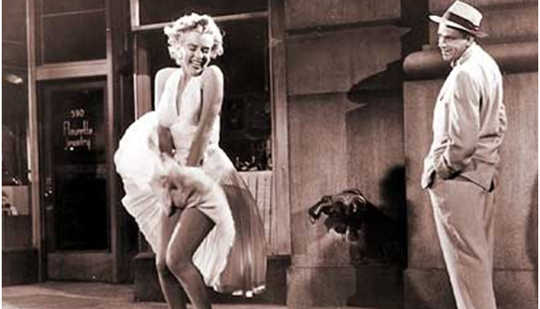 |
Marilyn Monroe still, “The Seven Year Itch" |
The same goes for women who've heard and been raised to believe things like "as their daughter I was taught that it was my role to serve, to be weak, to be free from the burden of thinking, to caretake and nurture others. My brother, however, was taught to be strong, to think, strategize and plan, and to refuse to caretake or nurture others" Bell Hooks. Personally being brought up in a home where women are encouraged to do as they please and follow their dreams, I did not directly face the terrors of patriarchy. However, being surrounded by old-fashioned individuals, social media, and modern-day cinema I could easily see how art and media have been modified all these years to deeper enroot these awful ideas within the newer generations too.
 |
| Patriarchy Stereotypes in Cartoon Form |
Even though these topics were wildly used a long time ago they are still relevant today, as they have not been completely resolved. And as these issues are diminishing new contemporary ideas are springing up like feminism. While females are striving to gain equality, many may believe that they are also the ones who are hindering feminism from setting in motion. This is because it is impossible to expect the same respect and rights as men possess when many women today willingly thinking it is still their duty to serve a man's needs before themselves. Situations like this occur when females are tied into an out-dated culture, mannerism, and upbringing. One may or may not agree to think that feminism is just another way to bring up the cries of patriarchy in slightly different means and descriptions. Click on the following link to explore further on this argument: Patriarchy a Rallying Cry for Feminism.
Work Cited
Berger, John. "Ways of Seeing." British Broadcasting Corporation, 1972.
Higgins, Charlotte. “The Age of Patriarchy: How an Unfashionable Idea Became a Rallying Cry for Feminism Today.” The Guardian, Guardian News and Media, 22 June 2018.
Hooks, Bell. "The Will to Change: Men, Masculinity, and Love." Washington Square Press, 2005.
Staff, InnerSelf. “What Does The Male Gaze Mean, And What About A Female Gaze?” InnerSelf, 6 Jan. 2016.

No comments:
Post a Comment