Jasdip Kaur
Professor Cacolio
Art and Women Post 1
February 10, 2020
Male Gaze and Patriarchy
The gaze is portrayed through the actions of how the crowd sees the individuals introduced in visual culture within literature and media. Male gaze is the ability of men to practice authority over women by visual methods as detached, sexual objects of male desire. The intensity of men over ladies has consistently existed throughout a long period of time. They are viewed as the more remarkable and smart species. This command over women has been seen predominately in semantics senses in past occasions. Simply there are more defamatory terms for women than there are for men. The term male gaze, itself, appeals to the sexual politics of the gaze. In other words, the term refers to when a women is viewed from the eyes of a heterosexual man where women have to represent as passive objects of the male desire. Scenarios of sexism are frequently and commonly present in society for an extremely long time now, as it has been promoted strongly by men.
Within literature, there are several who have brought up the topic of male gaze, however, European art critic, John Berger identified the literal meaning of male gaze. The male gaze according to Berger in his book Ways of Seeing, is when "men act and women appear. Men look at women. Women watch themselves being looked at," displaying that male gaze is essentially a form of mens actions towards a female figure (Berger 47). John Berger vividly sets forth examples and reasonings as to how and why male gaze is a common scenario in society. Within the literature, Berger comes across pieces during the Renaissance, stating, "You painted a naked woman because you enjoyed looking at her, you put a mirror in her hand and you called the painting Vanity, thus morally condemning the woman whose nakedness you had depicted for your own pleasure," suggesting that women nudity was a desire of many men for their own pleasure (Berger 51).
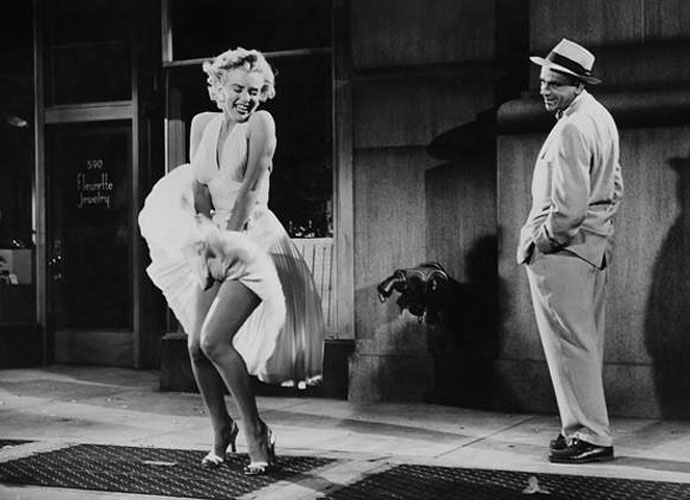 |
| Marilyn Monroe still, “The Seven Year Itch” |
As pictured to the left, Marilyn Monroe is one significant figure in history that has displayed the role of male gaze. There have been many scenes and pictures where Marilyn Monroe has been viewed by men around her, as they stare at her in awe because of her beauty and figure. With all of her physical features, men surrounding her, were displaying sexual attraction.
Another form of tyranny, within literature and media, towards women is patriarchy, where men consider themselves to be more superior over women. However, patriarchy was not a term that men would literally utilize, but a term which's actions were displayed.
Literary context is a great example to elaborate on societal patriarchy and the meaning of patriarchy. For instance, Bell Hooks', "Understanding Patriarchy," states that, "Patriarchy is a political-social system that insists that males are inherently dominating, superior to everything and everyone deemed weal, especially females..." (Hooks 18). Hooks displays that men ultimately consider themselves to be physically stronger than women due to one's gender, which is where gender roles plays a significant part as well. Another example of patriarchy Hooks uses is, "The contemporary presence of female-headed households has led many people to assume that children in these households are not learning patriarchal values because no male is present. They assume that men are the sole teachers of patriarchal thinking" (Hooks 24). Indeed there are situations where men play a significant role as a leader masculinely; however, that does not mean that women can not equally play the same role. Women are just as capable to equalize men, but during certain time periods (and surprisingly today as well), some men assume that women should not have the authority to portray a role of a female and male figure.
 |
| Patriarchy, Captain Marvel |
As shown on the right, there is a comic picture displayed in regards of patriarchy. Gender difference are shown within the picture. There is a female, who displays power in a feminine figure, while alongside her, is a male figure who is depicted to be bigger and stronger. However, the picture shows feminism strongly.
Although male gaze and patriarchy were more common during times in the past, there have been moments where it is yet still present. Of course it is not to the maximum point, but there is still a present of the two.
As a female, sometimes it is hard to walk past a group of guys without being cat-called. This is just a part of some people's lives where they are prone to exhibit their interest or tease a women through the form of cat-calling, which still occurs today. While patriarchy, unfortunately, still plays a significant role in today's world even after equality. There are several countries where men believe to be more superior than women, and make sure women are aware of it. For instance, in India, women are considered to get married into a family just to become none other than a housewife. A housewife, to take care of children, feed a family, and manage the house. While the man of the house is able to go out and work or even enjoy his life, while on the other hand, the women of the house, is left with nothing but the responsibility of taking cares of others at home.
Citations:
Berger, John. Ways of Seeing. British Broadcasting Corporation, 1972.
Hooks, Bell. The Will to Change: Men, Masculinity, and Love. Washington Square Press, 2005.
Hooks, Bell. The Will to Change: Men, Masculinity, and Love. Washington Square Press, 2005.

No comments:
Post a Comment