Overtime, the definition of
male gaze has changed as history continues to progress. The male gaze can be
defined as the view of a woman/female through the eyes of a man/male. The male
gaze is primarily about the objectification of women through the use of art
such as film, photography, advertisements, music etc. The male gaze is about
how women are objectified and portrayed in lenses fitting to a man’s
perspective. Women are constantly viewed as an object and never a subject
through the eyes of a man. The theory of the male gaze is used to dismiss the
true identity of a woman as they are just simply an “erotic” object for the admiration
for the males. Because women have become sexualized, dismissed of their
identity, it has led to a patriarchal society – in which males have become the dominate
gender in control. Men are always seen as the gender in control, the most
dominant gender compared to the role of a female. Because women have been so
sexualized, and placed as an object for entertainment, she is often times, not
taken seriously, as a man would.
John Berger states,
“She has to survey everything
she is and everything she does because how she appears to others, and
ultimately how she appears to men, is of crucial importance for what is
normally thought of as the success of her life. Her own sense of being in
herself is supplanted by a sense of being appreciated as herself by another”
(Berger 46). With the quote from Berger,
it goes to say that women have to constantly live up to this vision of a woman through
a male’s perspective and carry on this persona with them. In the media, women
are portrayed as a skinny, tall, beautiful, with the most perfect smile and
body – something many woman feel as if they need to live up too. In the media
such as film/cinema, there’s this vision set of a perfect girl in movies and
9/10 times, she carries all of those perfect qualities. In film, there is such
emphasis on the body of women and what she wears. They place women in these
scandalous outfits and zoom and photoshop different parts of her body to make
it mesmerizing for the sole purpose of capturing the male gaze – to attract the
male audience. Female characters are often placed in films in relation to the
man and often times she has no real importance to the plot. She serves more as
an accessory to the male figure than as a main character in films.
Society has placed these
expectations in place for women and failing to live up to such expectations
makes a female not as successful as the female who exceeds all expectations.
The look/personality women give off define who they are, and it gives them a
constant urge to feel as if they have/need to live up to such standards that
society has (sadly) set in place. Women are living in this image/persona of what
they need to be for society and not what they need to be for their self.
bell hooks states in her
text,
“Patriarchal thinking shapes
the values of our culture. We are socialized into this system, females as well
as males. Most of us learned patriarchal attitudes in our family of origin and
they were usually taught to us by our mothers. These attitudes were reinforced
in schools and religious institutions” (hooks 23). Society has taught/shaped gender roles – what women
are allowed to do and what men are taught to do. Society has it all planned out
for us before we are even born. Society has placed this sense of patriarchal dominance
and strength to the male gender, and weakness and vulnerability to the female
of gender.
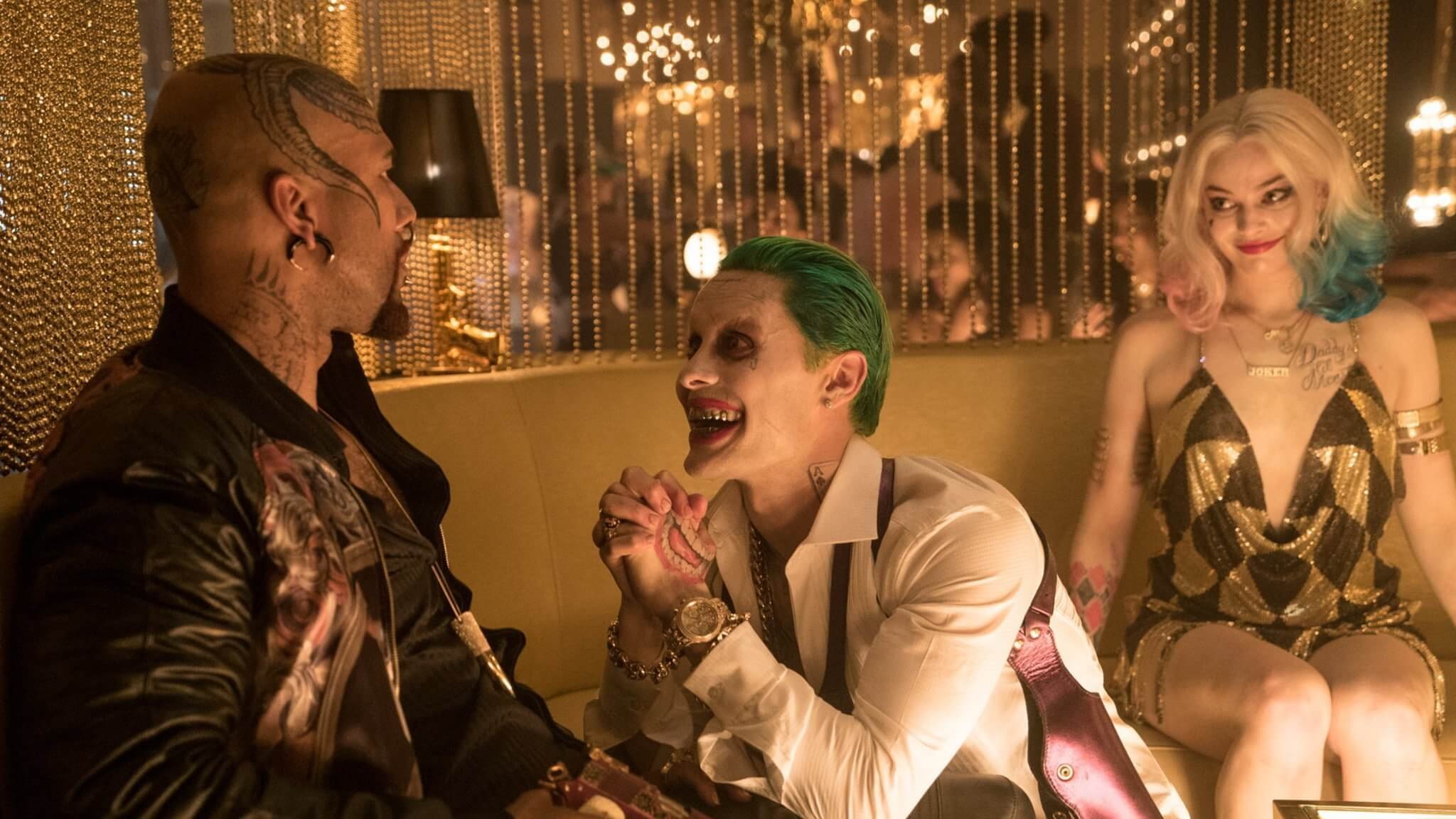 |
| Harley Quinn pictured alongside The Joker & Monster T in David Ayers 2016 film Suicide Squad. |
Take for example the most
popular movie – Suicide Squad, which was directed by a man (David Ayer).
Everyone knows of Harley Quinn because of her romantic relationship with the Joker.
She is often times described as, “hot”, “fun”, “badass” and well known for her red
and blue hair with her all-time famous shirt “Daddy’s Lil Monster”. Basically, Harley Quinn's character and story are a metaphor
for domestic violence – that is hidden through her character. Her backstory is
that she was a psychiatrist who was assigned to treat the Joker. He did his
Joker thing and manipulated her and twisted her into loving him and using her
for his own personal gain. Which is all a part of domestic abuse – but of
course, the film manages to portray her as a hot badass despite the real backstory.
In the film along with its trailers, she is constantly sexualized for her
looks. It all starts with the red and blue hair which leads into her scandalous
outfits. In multiple trailers, she becomes the center of attention – but not for
being a strong woman – but her body is portrayed in sexual ways on camera
making her buttocks and seducing looks the main image of herself in the trailers for the sole
purpose of capturing that male gaze. There were scenes that were spent scrolling her lithe form, lingering on her
breasts, her butt, her toned stomach as she tried on skin-baring outfits with
men surrounding her (as pictured above & below)– again all for railing in the male gaze and keeping them
locked in. The director, David Ayer chose to linger on her specific body parts,
and looking down upon the role of a female which only gave the male more
dominance throughout this film.
 |
| Harley Quinn alongside Deadshot which perfectly captures how the male gaze is perceived through the looks of its character Deadshot in the film Suicide Squad. |
Fast forward a couple of years
and films later. Female director, Cathy Yan, films “Birds of Prey” following
Harley Quinn post Suicide Squad. What a difference there is in both films – one
directed by a male, and one directed by a female. In the new film Harley Quinn
is portrayed as a colorful, cheerful, free-spirited, female who looks free from
her former lover. Birds of Prey is known as the film that deconstructs the male
gaze. Birds of Prey acknowledges the objectification that has been placed on females’
characters and rejects every single bit of it. One major difference is the way
the character is portrayed. She goes from this sexualized female wearing a
shirt with the saying “Daddy’s Lil Monster” in a bikini bottom to a loose-fitting
t-shirt with her name all over it paired with jean shorts (as pictured below). Her drastic change in outfit
goes to prove that she is a female and she is not here for the gaze of males but
for herself.
 |
| Harley Quinn in Cathy Yans 2020 film Birds of Prey representing her reintroduced/reimagined powerful-female-character as the famous Harley Quinn Citations: Berger, John. Ways of Seeing. British Broadcasting Corporation, 1972. Hooks, Bell. The Will to Change: Men, Masculinity, and Love. Washington Square Press, 2005. Birds of Prey Deconstructs the Male Gaze Harley Quinn Outfit Importance |

No comments:
Post a Comment