Gabrielle
Veintimilla
Professor Caçoilo
Art and Women
27 February 2020
Gender Roles, Subject,
and Power
For thousands of years,
women have undergone tremendous scrutiny and tribulations in juxtaposition to
their male counterparts and what determines their respective places in society.
History has long been retold and remembered to benefit particular groups of
people or individuals, and the same idea exists in the art world. Many great
works of art were attributed to a woman’s mentor, father, or husband because it
seemed unfathomable for women to be able to conceptualize and create such
masterpieces. Women, in practically every area of their everyday lives, were
restricted to the home and a life of domesticity. From the European Renaissance
and well into the nineteenth century and onwards, women were barred from doing
most anything outside of the home – including voting, being outside without the
permission or accompaniment of a male, paint, and so forth. Men had outlined
these expectations for women that they must be virtuous and pious individuals,
they must not become involved in the businesses her husband since it was a sign
of disrespect, they could not be educated, they must remain good housewives and
are responsible for maintaining the household and taking care of the children.
Women were made out to be very evil and untrustworthy creatures, as the poet Samuel
Butler noted: “The souls of women are so small, that some believe they have
none at all” (Guerilla Girls 29). From the Middle Ages, well into the
Renaissance and the centuries that followed, women had always been expected to
remain in the home and became mothers. Throughout those same periods, there
have been small exceptions to this expectation that allowed them to partake in
the art world to a degree.
With the collapse of the
Western Roman Empire, the Middle Ages emerged and saw a drastic transition for
women in this medieval society. Guerilla Girls points out that women in the
Middle Ages were no longer damsels in distress – they became active cogs in society,
evolving into writers, merchants, and great leaders (Guerilla Girls 19). The
Middle Ages called for an influx of demand for religious objects to uphold and
represent the moralistic teachings of the Church, and these requests were sent
to guilds, collective workshops, and religious communities. Although women were
allowed to work as artists (either by pertaining in workshops, guilds, family
businesses, or even in a convent), women were also under much scrutiny to obey
their husbands whenever it was deemed necessary (almost always). While women
were allowed to take up art, they could only really do so because it kept women
morally aligned with the teachings of the Church. However, society barred women
from becoming educated because it was believed that this would interfere with
them being able to run their homes efficiently, thus deterring them from
fulfilling their duties and obligations as good wives and mothers.
From the darkness of the
Middle Ages, Europe transitioned into an exiting cultural rebirth, and it was
predominantly a man’s world, which became known to the world as the
Renaissance. While history has long celebrated the works of artists of the era
– including Michelangelo, da Vinci, and Caravaggio to name a few – it has
scarcely celebrated the few women who were able to break from the mold that
European society and produce just as astounding masterpieces as their male
counterparts. Another vital piece of information of the Renaissance is as
follows: “The revision of guild regulations in 1340 reaffirmed the women’s
right to be admitted to full privileges and duties in the guild…Revised
statutes restricted membership to active entrepreneurs, women, and less-skilled
workers were left almost entirely without rights” (Chadwick 68). They were barred
from joining guilds, couldn’t earn a commission off the works they produced,
and could not own their ateliers to showcase and create their works – all of
which made becoming a female artist complicated and disheartening. However,
several women emerged from societal bars. They produced incredible pieces of
art that spoke to other themes than the constraints of religion that were seen
in the pieces that survived the Middle Ages. Scholars have noted that one
particular aspect from the Middle Ages was also found to exist in the
Renaissance: “A tradition of educated and skilled women in religious orders
persisted in the fourteenth and fifteenth-century Italy despite an increasingly
secularized society” (Chadwick 67). While female artists began to diverge from the
path of secularized paintings, remnants of it were found in some of the pieces
produced throughout the Renaissance, as it was the only way to be able to
compose pieces and be liberated from the guidelines that existed for female
artists outside of religious organizations. Women, Art, and Society makes it a critical point to emphasize:
“Convent life still made it possible for some women to paint.” (Chadwick 68).
The female artists of this time could become artists in very few ways. Women
who lived in a convent and practiced this lifestyle often avoided the scrutiny
that other women who perhaps painted in their fathers’ ateliers or other
places. Female artists that worked outside of convents included Maria Robusti,
whose father (Jacopo Tintoretto) dressed her in drag and stopped producing so
many pieces upon Robusti’s death (perhaps because he was grief-stricken or
possibly because his daughter was the one creating the art for him), Artemisia
Gentileschi, who worked in her father’s atelier up until she was raped by her
mentor (Agostino Tassi), and Onorata Rodiani, who dressed in drag to avoid
chargers for murdering a colleague who tried to rape her. Women of this time
did much more to step out of the boundaries that the patriarchy had established
for them and did not allow these efforts to be deterred. The more one attempts
to contain someone or something, the more likely it is to want to be liberated
from the confines it finds itself in. Outside of being an artist, women as
subjects in these very paintings was very constricted. Whitney Chadwick states:
“Their demeanor one of virtue, piety, and submission to the authority of the
husband, Church, and state, these female figures do not look; they are turned
away and presented as surfaces to be gazed upon” (Chadwick 76). One particular
piece that extraordinarily exemplifies this is Domenico Ghirlandaio’s Giovanna Tornabuoni nee Albizzi (c. 1488). The painting (see below) depicts
Giovanna as an object or a representation of her husband’s lineage. She is
adorned with her husband’s initials on her shoulder, and the family emblem is
embroidered onto her garment. As Whitney points out is often the case, Giovanna
is turned away from the viewer; she can be viewed, but she cannot see her
audience, thus enabling her to become a mere object. This particular piece is included
because it captivates what restraints the Renaissance had generated for women
of this period as both works of art and as artists.
In the seventeenth and
eighteenth centuries, little changed for women and their place in society. The
norm continued to remain that women were meant to be in the home and leading a
domestic life of motherhood (Guerilla Girls 39). Their role is to take care of
others (i.e., husband, children) in whatever house chores were needed to be
done and whatever else constituted as taking care of other individuals in the
life of a woman. Some women made a living as prostitutes – nearly 15% of the
adult female population – and others went into laborious jobs in the textile
and garment industries (Guerilla Girls 41). Being able to craft necessities
like clothes was as close to art as some women would be able to get to.
However, the eighteenth-century began to see a surge of the emergence of
professional women painters. Chadwick explains: They [female artists of the
eighteenth century] were able to negotiate between the taste of their
aristocratic clients and the influence of Enlightenment ideas about woman’s
“natural” place in the bourgeois social order” (Chadwick 139). This change for
female artists is drastically different from the female artists of the
Renaissance, who could not even collect a commission on the works of art they
produced, let alone suggest to a client a particular idea about a woman’s place
in society. Women at this time were able to create a lot more works of art, yet
the themes prevalent in these works were domestic scenes (i.e., portraits, a
still-life of fruits). The tides began to turn in the late eighteenth century
for female artists as they slowly began to emerge from the confines of the past
several hundred years.
In the nineteenth century, female artists revert to the
ideas of the Renaissance – where they dressed in drag to produce art – and they
also ventured out into new ways of creating art by living and expressing their
true selves. Aside from drag, women also lived abroad and formed powerful
artistic groups of sisterhood, where they were able to learn and mentor one
another. Cameras also begin to enter the creative scene at this time, and it
becomes a method of expression that was much easier for women to enter into, as
it was equally unexplored by men and women (Guerilla Girls 52). While women
became more focused on capturing scenes from everyday life, as Mary Cassatt
did, some sculpted historical figures (i.e., Edmona Lewis’s The Death of Cleopatra, c. 1876), and men became far more infatuated than
they had ever been with obsessing over and objectifying the naked female body
(Guerilla Girls 47). Audiences around the world applauded and celebrated men
making women their nude and sexualized muses. Still, if a woman were to create
something as daringly erotic – like Camille Claudel – they were shamed beyond
belief.
Ultimately, the roles
that women led throughout these tumultuous centuries in history to revolt
against the societal confines that restricted their sense of expression and
creative visions. To take back the power that had never really been given to
them in the first place, female artists looked for outlets to express their
creativity without limitations. Some artists, like Artemisia Gentileschi, produced
her rendition of scenes that had already been created by male counterparts and
took back the power for her female subjects like Susannah and Judith. In Judith Slaying Holofernes (see below), art critics and audiences alike who are
aware of the most pivotal moments in Artemisia’s life can realize that she is
projecting the hatred and anger she must feel towards Agostino for raping her
as Judith stares down the knife slicing into Holofernes throat. In Susanna and the Elders (see below), Artemisia can take a scene that
long painted and faulted Susanna with her violation of privacy from the elders
and portrays it in a much more accurate way. Other renditions show Susanna as
vain and blame her for being so self-absorbed that others can spy on her, such as Tintoretto's version (see below).
Artemisia’s piece shows the elders as evil perverts, who invade Susanna’s most
intimate moments. These experiences and roles that women underwent from the
Middle Ages through the nineteenth century certainly molded how women presented
themselves and artists, their artwork, and the subjects of some of the most
influential pieces ever produced.
 |
| Artemisia Gentileschi, Susanna and the Elders, 1610 |
 |
| Tintoretto, Susanna and the Elders, 1555-56 |
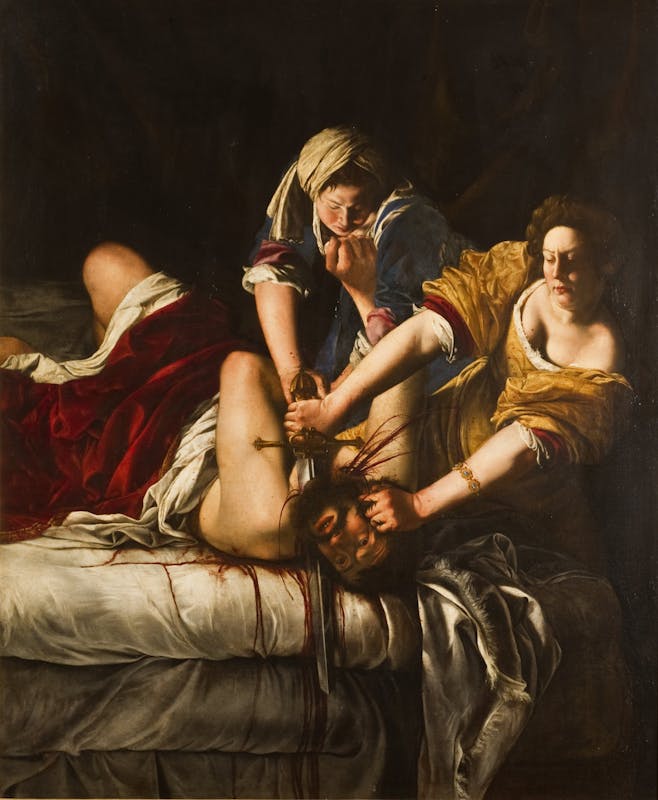 |
| Artemisia Gentileschi, Judith Slaying Holofernes, 1610 |
Works Cited
Chadwick, Whitney. Women, Art, and Society: Fifth Edition. Thames & Hudson, 2012.
The Guerrilla Girls' Bedside Companion to the History of Western Art. Penguin, 1998.