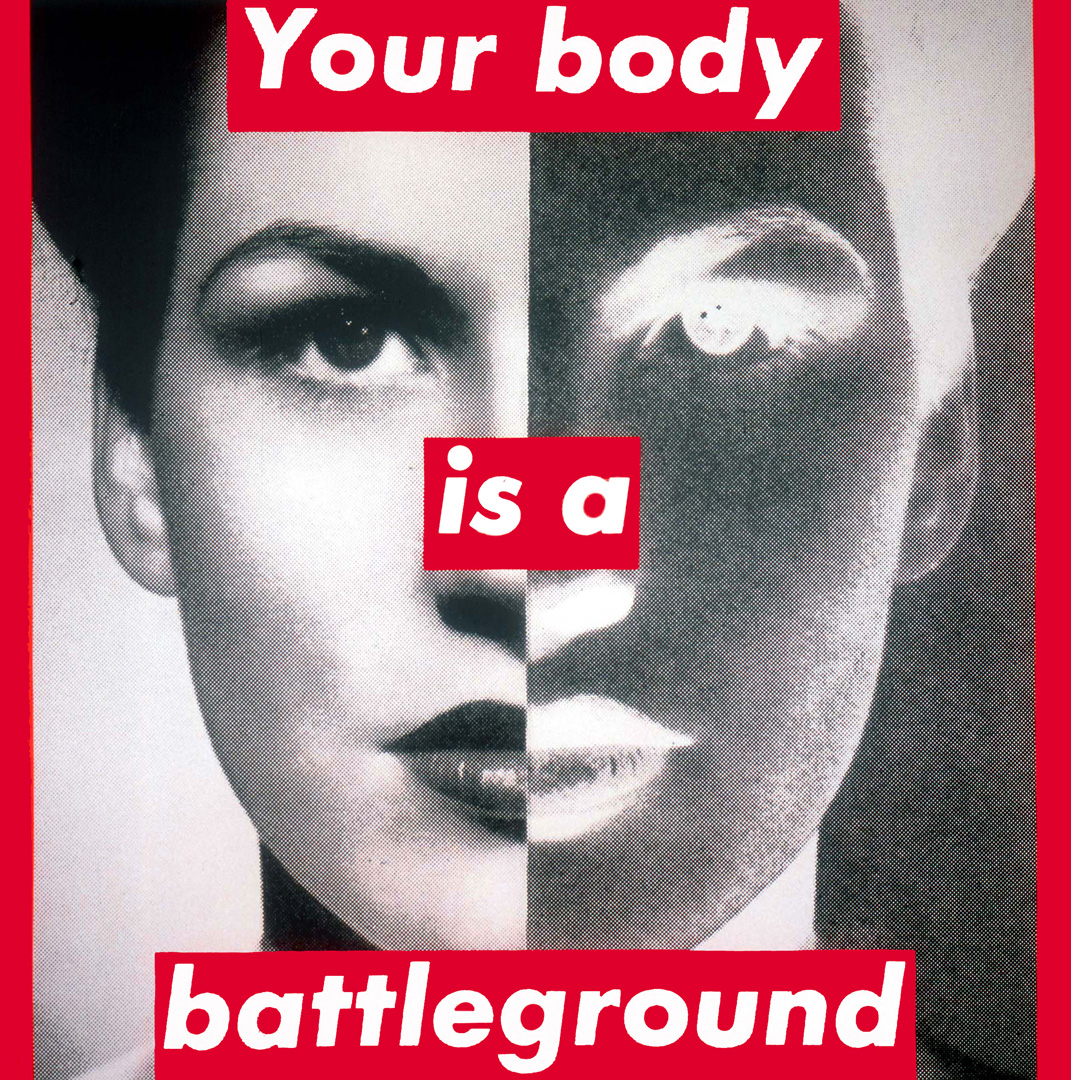
"Untitled (Your Body is a Battleground), Barbara Kruger, 1989
Barbara Kruger addresses media and politics in their native tongue: tabloid, sensational, authoritative, and direct. Kruger’s words and images merge the commercial and art worlds; their critical resonance eviscerates cultural hierarchies — everyone and everything is for sale. The year 1989 was marked by numerous demonstrations protesting a new wave of antiabortion laws chipping away at the 1973 Roe v. Wade Supreme Court decision. Untitled (Your body is a battleground) was produced by Kruger for the Women’s March on Washington in support of reproductive freedom. The woman’s face, disembodied, split in positive and negative exposures, and obscured by text, marks a stark divide. This image is simultaneously art and protest. Though its origin is tied to a specific moment, the power of the work lies in the timelessness of its declaration.
The large, bold artworks of Barbara Kruger assimilate words and images from the deluge of contemporary mass media. Employing media effects and strategies, Kruger creates her own sexual, social, and political messages, challenging the stereotypical ways mass media influences society’s notions about gender roles, social relationships, and political issues.

Georgia O’Keeffe (1887-1986)
ReplyDelete“Georgia O’Keeffe is known as the Mother of American Modernism. She is famous for her paintings of enlarged flowers, southeastern landscapes, and animal skulls” (artlistr.com).
I first saw her artworks while I was living in Santa Fe, New Mexico. Most of her creations had a tremendous impact on the colors and depiction. She was born in Wisconsin, so no wonder why she focused on drawing mother nature. At the time when she was still not famous yet, most artists were men, as such, her works did not draw attention. It was in 1920, the 19th amendment granted women the right to vote, and she was already 33-year-old. It is hard to imagine living without a legitimate right, which means women needed to follow what men decided.
Blue and Green Music (1919)
The image from © The Art Institute of Chicago
https://www.artic.edu/artworks/24306/blue-and-green-music
She saw a silver lining when she married her husband, Alfred Stieglitz, a photographer, but also an art dealer. He suggested her not to do water painting and called her artworks, the image of women’s genitals. He likely wanted to build a valuable reputation on her creations because he knew how to sell arts, putting high prices to make a living. He was very familiar with American Modernists through his business and friends since he was a photographer, but also an art dealer. He suggested her not to do water painting and called her artworks, the image of women’s genitals. He likely wanted to build a valuable reputation on her creations. He was much wiser than she was.
Red Canna (1924)
The image from © 2011-Present www.GeorgiaOkeeffe.net
https://www.georgiaokeeffe.net/red-canna.jsp
She wanted to have children, but it was Steiglitz’s idea if they had children, her career would be ruined. He died in 1946, so O’Keeffe was single for 40 yeas after the loss of her husband and a business partner. Around the time, she moved to Abiquiu, New Mexico to focus to create more artwork. She and her assistant went out every day no matter how the weather was. I wonder how it was like because nowadays, we have everything we need from the heat, A/C, food, medications, vehicles and a cell phone. We may not know how to survive if we lost in the mountain or desert. Her life was difficult to go through and lot of patient required to create such beauties especially through the Great Depression, World War I and World War II eras.