Friday, January 31, 2020

Frida Kahlo - Mohan Prasat


Frida Kahlo

Frida Kahlo is a female Mexican painter whose artwork can be used to understand the world in which she lived as well as offer insight into the way she identified herself. Frida Kahlo grew up surviving and battling lifelong struggles with sicknesses including being diagnosed with Polio at an early age leaving her permanently disabled. As her life progresses, more serious illnesses would follow, including pneumonia and a forced amputation eventually leading to her untimely death. Frida Kahlo was one of few women of her time to receive a proper education, and this would help shape her strong political views prior to the Mexican Revolution.


Frida Kahlo's paintings can be understood as a reflection of herself. In the painting pictured with the thorn necklace, it can be understood that Kahlo must have felt helpless as the thorns would be causing harm. This can be depicted by the time when she was painting this piece, which was during a period in which she was extremely sick in the hospital after being involved in a serious accident. Her art pieces attempt to capture and reflect herself in her current moments or capture a moment in which she depicts herself in her own style.

Frida Kahlo Bio

Thursday, January 30, 2020

Simone Leigh Mini Post #1- Faith


Image result for simone leigh newark museum
Simone Leigh (Top Left)


Simone Leigh is an African-American female artist whose work primarily focuses on the object associated with the African diaspora, and the practice of expressing black female experience. Leigh is a sculpture, video, and installation artist. Her work is comprised of wax casting, and ceramics as well as shells and plantains. Leigh’s work is based on the stereotypes of black women, however, twists the narrative and represents it in a positive way. Expressing the beauty of black women, and the celebration of black life and culture. Leigh is very engaged with the history of the African-American community and its rights. Her work connects with black rights organizations and unknown networks of black women nurses during slavery.

One of her projects “Free People’s Medical Clinic”, done in 2016 was a temporary space for wellness services performed by and marketed towards black women and their health. The project was based in a brownstone owned by the first African American female OBGYN. Some of her other works include sculpture of African-American faces with mixed media materials attached to them in a decorative floral pattern. Leigh also has some works at local locations like the Newark Museum, her shell beads represent the beauty of black women and hair.

Tuesday, January 28, 2020

Mini Post #1 Amanda Allen Niday

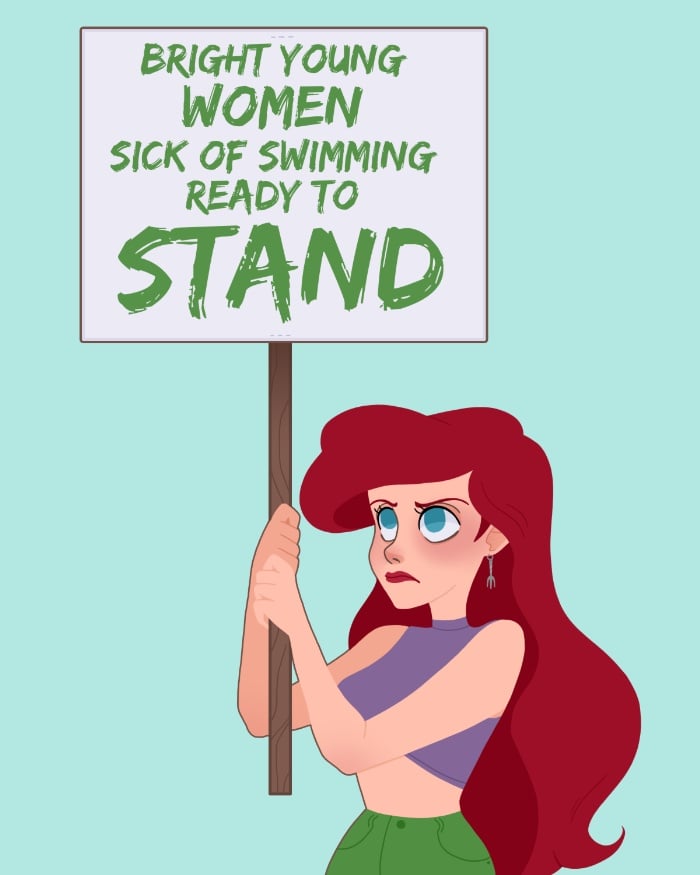
Amanda Allen Niday, Disney Princesses Standing up for Their Rights. 


Amanda Allen Niday is a Portland born artist that focuses and uses her love for comics and Art History to create her own work. One of her more known collections is Protesting Princesses. Niday puts her feminist views into her work such as the piece above. Her work is mainly stretches and drawings for Disney or 90s cartoons and comics; she puts a spin on the traditional characters that she grow up seeing.

The artist, Amanda Allen Niday, re-imagines and displays our favorite Disney Princesses in a more feminist role in the drawing above. The idea behind her art is to get the message out to her views about the stance women take and to redefine these princesses as strong independent women. Artist Niday most likely chose Disney Princesses because young people, mainly girls grew up looking up to them and had these princesses as their role model; now grown, the same women can view these Princess in a different light. 

The message portrayed by Ariel states, "Bright Young Women Sick of Swimming Ready to Stand" which can be interpreted in many ways. One can be that women are tried of following the current and instead they are going to rise and stand against the current and stand up for themselves. 


Artist's Personal Blog:
https://www.patreon.com/amandaallenniday

"Georgia O'Keeffe" By Haliey Gonzalez | Mini Post #1 | 01.28.2020

Georgia O'Keeffe, Autumn Trees - The Maple, 1924

Georgia O'Keeffe, Oriental Poppies, 1927

Georgia O'Keeffe, The White Flower, 1932

Georgia O’Keeffe:

Georgia O’Keeffe grew to be one of the most popular artists for abstract expressionism and modernism in the 20th century. Her work is heavily influenced by the multiple communities which she identified with and/or was exposed to as a growing artist. A great majority of her paintings are revolved around the depictions of flowers and their blooming nature. The manner in which O’Keeffe uses a variety of contrasting colors and shapes to give life to the flowers she chose to portray, is what has helped shape her popularity as a female artist. O’Keeffe’s ability to focus on the simple, yet complex nature of flowers has opened a window of opportunities for other female artists alike. Who particularly aim to break artistic barriers society, the art world, and male artists have put in place both intentionally and unintentionally. 

For many years O’Keeffe argued her work was not meant to depict anything relating to feminist ideologies. Despite this, the artistic freedom she allowed herself to express has driven many to view her, as well as her work as representations of feminism. Many fans – specifically those involved with the feminist movements of the late 20th century – chose to interpret her work of art as a representation of the female genitalia (the vulva to be exact). For these women interpreting O’Keeffe’s work as such, allowed them to feel supported in their efforts to take back their power as women in a society that often dominated their every move. O’Keeffe’s work provided an opportunity to connect as a minority group (women) that are often oppressed by society through numerous avenues. 

Relating Links:
1. Flowers or Vaginas? Georgia O'Keeffe Tate show to challenge sexual cliches | The Guardian
2. Georgia O'Keeffe's controversial paintings | Exotic Flowers Blog
3. Georgia O'Keeffe Overview | Artsy

"A Pioneer of Modern Egyptian Art"


Born in Cairo, Egypt in 1924 to the Dean of Cairo University's Science Faculty and the founder of the entomology department and a French-trained dress designer who also served on the women's committee of the Egyptian Red Crescent Society, Inji Alfatoun grew as a person and artist in what she described as a "semi-feudal and bourgeois" family of origin.  With her privilege and the opportunities provided to her by being born into an upper-class Francophone family, Aflatoun was able to begin her career under the guidance of her mentor Kamel El Telmissany, an Egyptian painter, at the age of fifteen.


Aflatoun's work was influenced by her discomfort with class structure, which she was first exposed to in childhood while attending a strict Catholic School.  Once beginning her work with El Telmissany, who's work was primarily a satire of Egyptian cultural norms, Afaltoun began creating art using the theme of a surreal and alternate universe of darkness and disasters and focussing her work around women.  Some of her early pieces are these provided, which show women fleeing from violence and fire, primarily being oppressed through the men surrounding them. 
As Egypt began to release itself from British imperial rule, Aflatoun began working as Egypt's pioneer feminist to embark on legal rights for women.  As the author of two political pamphlets by the ages of twenty-four and twenty-five, Aflatoun was imprisoned in the mid-1950s by the Egyptian government as suspected of communism, which she only used to fuel her third political work titled "Prisoners" (1957).  After her release, she spent the following two decades dedicating herself to the pursuit of fine art.  Following her feminist lifestyle and the things she had learned under the mentorship of a surrealist, Aflatoun continued to create paintings of strong Muslim women and brought the Egyptian working class to life through her art.
I chose to highlight the work of Inji Aflatoun because it is human nature to become attracted to the things which we can identify with personally, and as an Egyptian woman with a passion for women's' rights, I found pleasure in researching her story and her art.  As Aflatoun set out to represent some of the most underrepresented communities within Egypt, using her talents to do so, I, too, hope to serve women in need from Middle Eastern and North African countries.  Additionally, her ability to switch from vibrant colors to mundane browns and greys in separate paintings and her ability to tell stories through not just the image being presented but by her choice of paints and brush strokes are admirable.  Aflatoun was able to take the portrait of the working-class Egyptian woman, which most followers of traditional Egyptian culture turn their noses up at, and create a world in which they were considered beautiful and worthy of praise.

The concept of art is not lost on Inji Aflatoun; she took her world and created so many others in response.  This is why Google chose to celebrate her on what would have been her 95th birthday.


Mini Post #1


Image result for barbara kruger
Barbara Kruger, 77% of anti-abortion leaders are men. 100% of them will never be pregnant., 1989

Barbara Kruger was a conceptual artist born on January 26,1945, in Newark, NJ. Barbara Kruger is known for her pieces in relation to women and gender politics. Most of her work consists of black and white photographs which shows an interesting correlation with the topics her pieces focus on. She has an impact through work, by portraying a message of gender roles.

In the image above, it says "77% of anti-abortion leaders are men. 100% of them will never be pregnant." What is so important about what is said in the picture is because men voting on abortion laws, something that is a big and important issue in our society today, are in fact MEN. They have no idea the ordeals a woman has to go through for an abortion to actually happen, and it's not like abortion is taking away anything from these men besides disagreeing with their ideologies and beliefs. The reason why this piece is so powerful is because numbers are definitely something that is perceived as eye-catching to humans and to see a number as 77% makes you realize how close that is to the number 100 and how that many men should not have the power to make decisions about issues that are made for women.

https://art21.org/artist/barbara-kruger/?gclid=EAIaIQobChMI75DDyNyn5wIVhJ6zCh2gAQrVEAAYASAAEgLxQPD_BwE

Mini Post: Cindy Sherman

Cindy Sherman is a female artist that has devoted her artwork to women everywhere. Cindy is a photographer and filmmaker, who likes to draw attention to the portrayal of women in everyday life. Today the image of women has been reflected on through the use of social media, television, and through discussion by head figures. Cindy Sherman has decided to join forces with many female artists to show a different inside look on the portrayal of women. Cindy is often known for her look on femininity as a social construct. Cindy herself poses for her images and films to show the stereotypical depiction of women. As Cindy explained, "I like making images that from a distance seem kind of seductive, colorful, luscious and engaging, and then you realize what you're looking at is something totally opposite".  This quote resonated with me as I feel it defines the type of artist Cindy was perfectly. A women who wanted to not only create art and display it, but to really become the art herself. Photography and filmmaking are both styles of art that take images and capture moments that create one larger moment. Being able to represent an entire decade through a short film or use of images to spark the essence of a time. Cindy used her own body to create her art, which truly spoke to me and the audiences she is trying to reach. By using her own body she in a sense is taking back the power the women she portrays lost.
#92 chromogenic color print, Cindy Sherman
I find this image Cindy captured to be the most interesting of some of her work. Referring back to  the quote I mentioned above, this image is displaying the very idea she mentioned. Wanting to have someone look at her work and find a women who appears seductive and engaged. After looking closer at this image I was able to see the fear in her eyes. This image gives off a cold feeling to better enhance the fear and realization we see in the women eyes, body language, and the images dark surroundings. Focusing more on her posture, her hands are flat on the ground and legs tucked under her body, which to me says that this women in this photo is searching for a place to run but is unsure where or if she can escape. The placement of her hands could be at any moment she is going to push herself up but by the hunch in her shoulders indicates that may not be possible. The women is looking at something that frightens her and we can see she is looking towards the side and behind her. Though we don't see a figure or know what threat is surrounding this women, it is still made clear that this women is in some type of distress. Cindy's photography has captured many moments in time also depicting women of different eras and drawing attention back to images of women from the past she feels are still relevant today.

Joan Rivers, an American Icon

     Joan Rivers was an American comedian who never worried about pushing the bars of what were and were not socially acceptable conversations on topics including but not limited to: women’s rights, politics, cosmetic surgery, and historical tragedies such as 9/11 and the holocaust. Joan famously said, on many occasions, when she would be asked if there is such a thing as going too far with a joke: ‘if you can’t laugh at it, you can’t deal with it.’ I recall once in one of her shows she made a joke about either Anne Frank or the holocaust in general, and the crowd sort of awkwardly cringed—which she expected—and she said, ‘what too soon?’
     This begs some bigger questions, and something I learned from Joan’s work. What is the socially acceptable amount of time to wait before talking about tragic events, and is it disrespectful to utilize the references in a comedic setting or is that just an avenue in which many people can heal from the trauma? It has been nearly two decades since the 9/11 attacks in New York, but still the vast majority of us shy away from casual talks of it. I personally follow Joan’s approach, the way I best deal with things is through humor.
     I am an EMT in the city of Newark, and as such I see some veery challenging things on a regular basis. People do not often think about the worst days of their own lives or the worst days of others people’s lives, but I have a special VIP backstage pass to those events and often am emerged in the middle of these tragedies. I do not mean for this to turn into a narrative of me whining about my job because I love my job and this is meant to be a tribute to Joan, however what I am getting at is that like Joan, I use humor to deal with what I witness. I do not make jokes to make light of the situation my patients are in or to disrespect them, I make a joke because it helps me make order of the chaos in my head from seeing what I saw.
     Joan is a legend and has always been an advocate for the betterment of women’s rights and rights of everyone else who may have had their voices diminished. She was the first woman to host a late night show and made so many other groundbreaking accomplishments in her lifetime. She was taken at 81—with more energy than I have every had—but her years were extremely impactful, to women, to LGBT members, to anyone who was hurting, an especially to me—a gay EMT from New Jersey who would much rather laugh than cry.
Joan Rivers guest hosting the Tonight Show (first woman to do so) March 6, 1986
Joan Rivers' book cover released December 30, 2008

Mini Post #1 Barbara Kruger

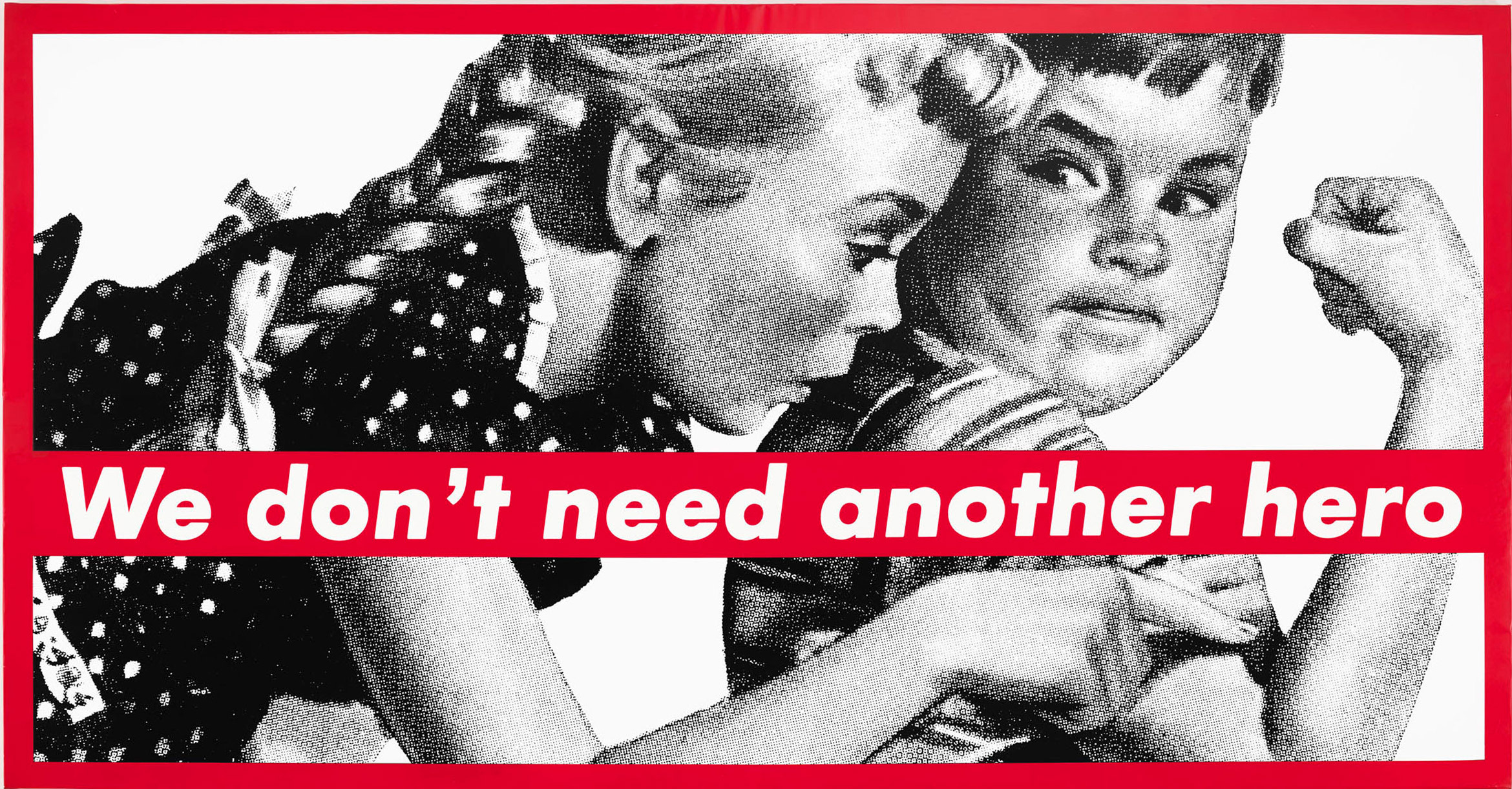
Barbara Kruger, We don't need another hero, 1987

Barbara Kruger, a conceptual artist, was born on January 26, 1945 in Newark, NJ. Kruger is well known for her artistic pieces in regards to women and gender politics, as most of her work consists of black-and-white photographs. She displays a source of impact through her work, as she portrays a message of gender roles through art. She is well known the way she depicts her silkscreen prints with a direct caption regarding the print.

In Barbara Kruger's artwork, We don't need another hero, the girl is pointing towards the little boy's bicep. Through visualization, you can depict the boy portraying himself as a strong, masculine figure in comparison to the girl with the pig-tails. Along with that, the girl displays herself being mesmerized or fascinated by the masculinity of the little boy. However, Barbara Kruger, in bold text, says "We don't need another hero." Therefore, she is ironically contradicting the art work to its texts. As the artwork is designed to show male masculinity and superiority, the text says otherwise, as she contradicts the general stereotype of women needing men. In conclusion, gender roles as we see them in the image are too restricting, no-one can fit perfectly into these male or female role.

Additionally, directly speaking of Barbara Kruger's work, it can also relate to the idea of another hero not being needed, as the time frame of this work was during the time period of the war. This could be an interpretation of the relation of women during the war and after the war. 


Mini Post #1: Chitra Ganesh

Ami Shah
28 January, 2020
Professor Cacoilo
Art & Women
Mini Post #1: Chitra Ganesh

Chitra Ganesh is an Indian-American visual artist that was born and raised in Brooklyn, New York. She attended Brown University and later taught as a high school teacher before becoming an artist. It wasn't until her mother died that she devoted herself to her artwork and completely changed career paths. Ganesh initially was very hesitant about pursuing art, but still did so as the death of her mother reconstructed her purpose and outlook on life. In her pieces, Ganesh draws much inspiration from Hindu/Buddhist mythology, comics, politics, and feminist and queer narratives. She is also renowned for depicting women in positions of power and representing sexuality in a unique and unconventional light.

Depths of Her Abyss, 2016. Chitra Ganesh
The Arrow, 2016. Chitra Ganesh
This piece is especially fascinating as it both breaks down and uncovers the many stereotypes that follow South Asian women. Each individual, draped in traditional attire (sarees), is seen sitting in solidarity as one woman points her arrow towards an unknown direction. The saree is particularly important as its vibrant colors largely emphasizes the diversity within the South Asian community and serves as a symbol for daily life. In many South Asian countries, sarees are viewed as respectful items of clothing that are regularly worn by women throughout the day. However, because of that, the saree is also often associated with words such as "weakness" and "fragility" as the women in the society are expected to be obedient and cooperative. Though, in Ganesh's piece, although the women are wearing traditional clothing, it does not prevent them from protecting themselves from the anonymous, oncoming threat. Ganesh's The Arrow, confronts preconceived notions of South Asian women and portrays them in ways that are not common, and oftentimes taboo, within the community.

Mini Post- Yolanda Lopez


Silvy Matos
01/28/2020
Art and Women
Blog Mini Post
                                                                        Yolanda  Lopez
              There are many inspiring feminist artists that have invested their time and money creating magnificent art pieces, not for a pass time, but to make a change in this world. Although all feminine artists are unique in their own perfect way an artist that truly intrigues me is Yolanda Lopez. Lopez represents a population of Chicana feminists; she is a conceptual artist that uses her artwork to challenge political and social corruptible beliefs. Through her paintings, Yolanda Lopez, defies stereotypical modes of Latino/a/x representations, and she challenges these ideas by creating new ideas of gender, race and cultural identity. 

              The majority of her famous artwork pieces focus on the life and hardships a Mexican woman goes through. Lopez was born in 1942, in San Diego, California. She was 1 of 3 daughters in a family in which she was raised by her mother and her grandparents in part from her mother’s side. Growing up in the United States she came to realize the racial stereotypes in the country, through her paintings she wanted to defy these ideas of Mexican women and portray the truth of being a Chicana. Lopez is famously known for her groundbreaking series of the Virgin of Guadalupe in diverse political views.

Yolanda Lopez, Portrait of the Artist as the Virgen of Guadalupe,1978.
Yolanda Lopez, Margaret F. Stewart:Our Lady of Guadalupe,1978.
Yolanda Lopez, Guadalupe:Victoria F. Franco,1978.

  
In Mexican culture the Virgin of Guadalupe is a very famous well-known religious figure that is associated with motherhood, feminism, social justice, and more. Lopez creates a series of paintings of her family in this case, her mother, her grandmother, and herself with the background of the virgin of Guadalupe painting. It is a way to state to Mexican women that although religion is very important, they need to start praising themselves as females, workers, etc. To represent Mexican women as powerful figures that can make their own decisions and fight for their desires. The goal of these painting was to show Chicanas around the world that they do not need to adapt to certain things because it is viewed in such a way for Mexicans. Through these painting Lopez was trying to honor the female working class, all kinds of women no matter their age, and powerful women. Women in society are usually viewed as weak compared to men and Lopez wanted to change that. This can be seen through the way she paints the physique of the women body with strong muscular legs. She wants primarily through her work to help Mexican women fight against oppressive social shame that in previous years have limited women to express their personal/ political beliefs and morals. Through her series she shows how her family generations of women members have changed throughout the years. Her grandma has fought all her life and is now at peace with herself, her mother worked all her life to give her daughters a great life, and in the last series we see Lopez leaping and grabbing the serpent by the neck which represents all the work her previous generations went through to give her the life she has and help her spread her wings to accomplish all her goals. As for the serpent she is grabbing by the neck it may represent society and people holding her back and she won’t allow it.


Mini Post


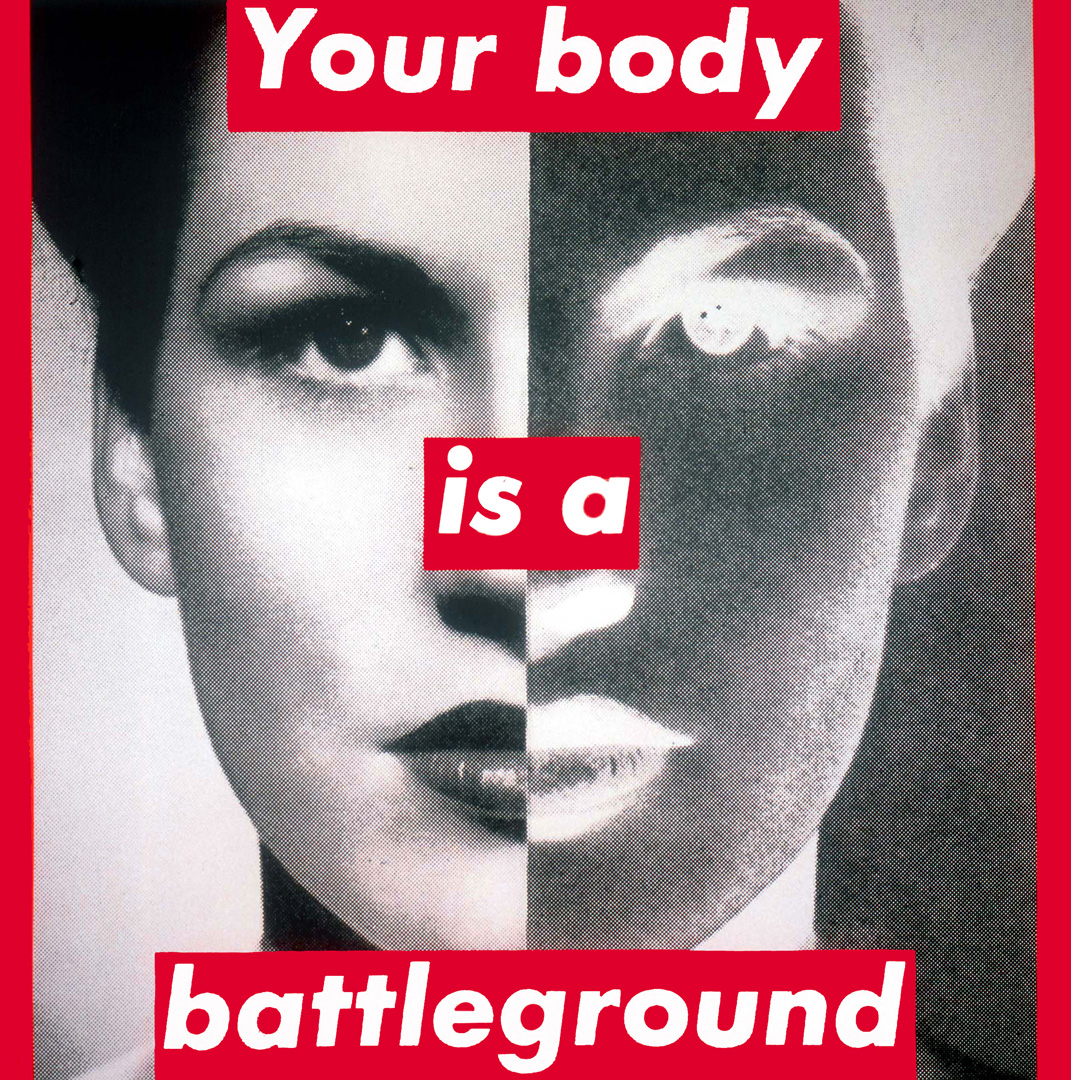
Barbara Kruger - Untitled (Your body is a battleground), 1989, photographic silkscreen on vinyl

"Untitled (Your Body is a Battleground), Barbara Kruger,  1989


Barbara Kruger addresses media and politics in their native tongue: tabloid, sensational, authoritative, and direct. Kruger’s words and images merge the commercial and art worlds; their critical resonance eviscerates cultural hierarchies — everyone and everything is for sale. The year 1989 was marked by numerous demonstrations protesting a new wave of antiabortion laws chipping away at the 1973 Roe v. Wade Supreme Court decision. Untitled (Your body is a battleground) was produced by Kruger for the Women’s March on Washington in support of reproductive freedom. The woman’s face, disembodied, split in positive and negative exposures, and obscured by text, marks a stark divide. This image is simultaneously art and protest. Though its origin is tied to a specific moment, the power of the work lies in the timelessness of its declaration.

The large, bold artworks of Barbara Kruger assimilate words and images from the deluge of contemporary mass media. Employing media effects and strategies, Kruger creates her own sexual, social, and political messages, challenging the stereotypical ways mass media influences society’s notions about gender roles, social relationships, and political issues.

Mini Post #1 - Latoya Ruby Frazier


Arly Navarro
Art and Women
January 28, 2020

Mini Post #1: Latoya Ruby Frazier

Latoya Ruby Frazier is an artist from Braddock, Pennsylvania. In her artwork, her photography projects, she portrays the American Industrial decay, healthcare and environmental justice. These photographs make capture injustice in a way that it is right in the face of the audience. She is raising awareness of the contemporary social/political issues in society. While growing up in Braddock, she viewed many of the same injustices occur within her community and documented them through her photography.

Frazier's most famous artwork was from her project, The Notion of Family. This project was a 14-yearlong series of portraits taken in Braddock, demonstrating how her own family is impacted by injustice in America. The vulnerability and intensity is depicted in her artwork. One of her pieces from The Notion of Family shows her own mother in a Braddock hospital bed, dying from pancreatic cancer. In her other artworks, she reminds everyone about the water crisis that is still occurring in Flint, Michigan. She states that the photograph frightened her because it was a scene that would look like it would come from 1968 but it was taken in 2016, when Obama was about to come to Flint.

Link: http://www.latoyarubyfrazier.com/work/

Ms. Frazier's mother in a Braddock Hospital bed. 2002.
LaToya Ruby Frazier, From The Notion of Family, 2002
Latoya Ruby Frazier, A Child showing me a Wanted Poster of Michigan Governor Rick Snyder outside North Western High School (est. 1964) awaiting the arrival of President Barack Obama, May 4th 2016 Flint MI 2016. 2016/ 2017. Gelatin silver print, 24 x 20 inches (61 x 50.8 cm), 28 x 24 inches (71.1 x 61 cm) framed. Edition of 3 with 2 APs. © LaToya Ruby Frazier. Image: Courtesy LaToya Ruby Frazier and Gavin Brown’s enterprise, New York/Rome. The American Academy of Pediatrics feels that Congress should provide Flint with even more than what is currently under consideration in the Senate. Specifically, the AAP supports federal efforts to provide additional funding for long-term educational, early literacy, nutrition, medical, behavioral, and other assistance to this community. This includes, but should not be limited to: support for all of Flint’s approximately 8,000 children under 6 to enroll in Head Start and Early Head Start; quality child care; literacy programs; Medicaid and Children’s Health Insurance Program enrollment; the Special Supplemental Nutrition Program for Women, Infants, and Children; school meals and afterschool feeding programs; and mental health screening and treatment. — The American Academy of Pediatrics
LaToya Ruby Frazier, A Child showing me a wanted poster of Michigan Governor Rick Snyder Outside North Western High School awaiting the arrival of President Barack Obama, 2016

Monday, January 27, 2020

mini post 1

Carl Boateng


Mary Cassatt is an impressionist artist who is consistently regarded as one of art history’s most famous female painters. She was an unmarried American woman living in Paris, but that didn't stop Cassatt from making a name for herself in the male-dominated movement, defying 19th-century gender expectations and paving the way for future female artists. Understanding the context of her art is an important aspect of appreciating her role in both Impressionism and in the realm of modern art.

Image result for mary cassatt art explained

In this important work of her mature career, Cassatt chose to portray a young girl alone in a domestic interior. The visible brushwork and the figure's informal pose are trademarks of Impressionism. Impressionism is the asymmetrical composition, raised viewpoint, shallow space, and abrupt cropping of the scene all indicate the influence of Japanese art. Cassatt also brings her own observations to the construction of this image. The girl is seated in a sprawling, unselfconscious manner that reminds the viewer of her young age, and the way that she is sunk in by the adult furniture around her evokes the awkwardness and isolation of certain stages of childhood.


Mini Post - Elaine Sturtevant

Emanuel Marques
1/27/20

Female Artist: Elaine Sturtevant 


Elaine Sturtevant, Warhol Marilyn, 1965. 

Elaine Sturtevant, also known as just her last name Sturtevant, is an American female artist who was famous for imitating famous male contemporary artists such as Andy Warhol, Roy Lichenstein, Robert Rauschenberg, Jasper Johns and others. Sturtevant’s replication of male artists work boldly challenges social constructs around gender roles and individuality within the art community and society. Sturtevant’s art of appropriation which proceeded World War II, sought to reinvent contemporary American art, while highlighting the lack of representation of women in art community, as well as all other professions at the time. Sturtevant’s appropriation of other contemporary artist’s work brought to light the non-inclusive environment for women in the art community in the United States. She also questioned the meaning of originality with her artwork, while promoting the notion that appropriation art takes other’s work and adds her own interpretation of the work.

The picture above is one of Sturtevant’s works of art, named Warhol Marilyn, in which she remade Andy Warhol’s painting Marylin Monroe. This specific Sturtevant painting received much attention as Warhol himself reluctantly gave her the screen-maker that he used for his painting. Later, when someone asked Warhol about the process of painting the Marilyn Monroe, he would spitefully respond, “Ask Elaine”.

Sturtevant’s work faced plenty of resistance throughout her life, which discouraged her to the point of not displaying her art for over ten years, starting around the early 1970s. One particular instance of push back that Sturtevant’s work received was from a male artist regarding her repetition of Claes Oldenburg’s The Store, mainly because her work was housed walking distance away from the original painting.

https://www.nytimes.com/2014/05/17/arts/design/elaine-sturtevant-appropriation-artist-is-dead-at-89.html

Mini Post

When thinking about female artists who identify a cultural, social or political issue, Maria Qamar comes to mind. Qamar was born in Pakistan and later moved to Ontario which would play a huge role in how she depicts the life and times of first generation Indians living in the west. She touches upon patriarchal roles as being a woman as well as the cultural norms of being an Indian woman. 

What I believe plays a huge part in her success is taking everyday phrases of a Pakistani household and uses it in a form of word play. For example, one of her illustrations is of two women kissing and she titles it "st8 like a jalebi." A jalebi is an Indian sweet popular dessert where it is molded into pretzel like shapes that are in fact not straight at all. This is a great example of how she crosses cultural "norms" to create conversation on social issues like sexuality and gender roles. Not only does she talk about these issues but she portrays them in a way where its relatable to her audience and they can envision themselves in these situations. In some cases, she might be an outlet to people who can not express their views to their families because of their cultural "norms." Amongst more of her work, Qamar does a great job of speaking directly to her audience in form of welcoming and inclusion, especially for the women of a South Asian culture. 

Maria Qamar - aka "hatecopy"
website


Mini Post #1 - Artemisia Gentileschi

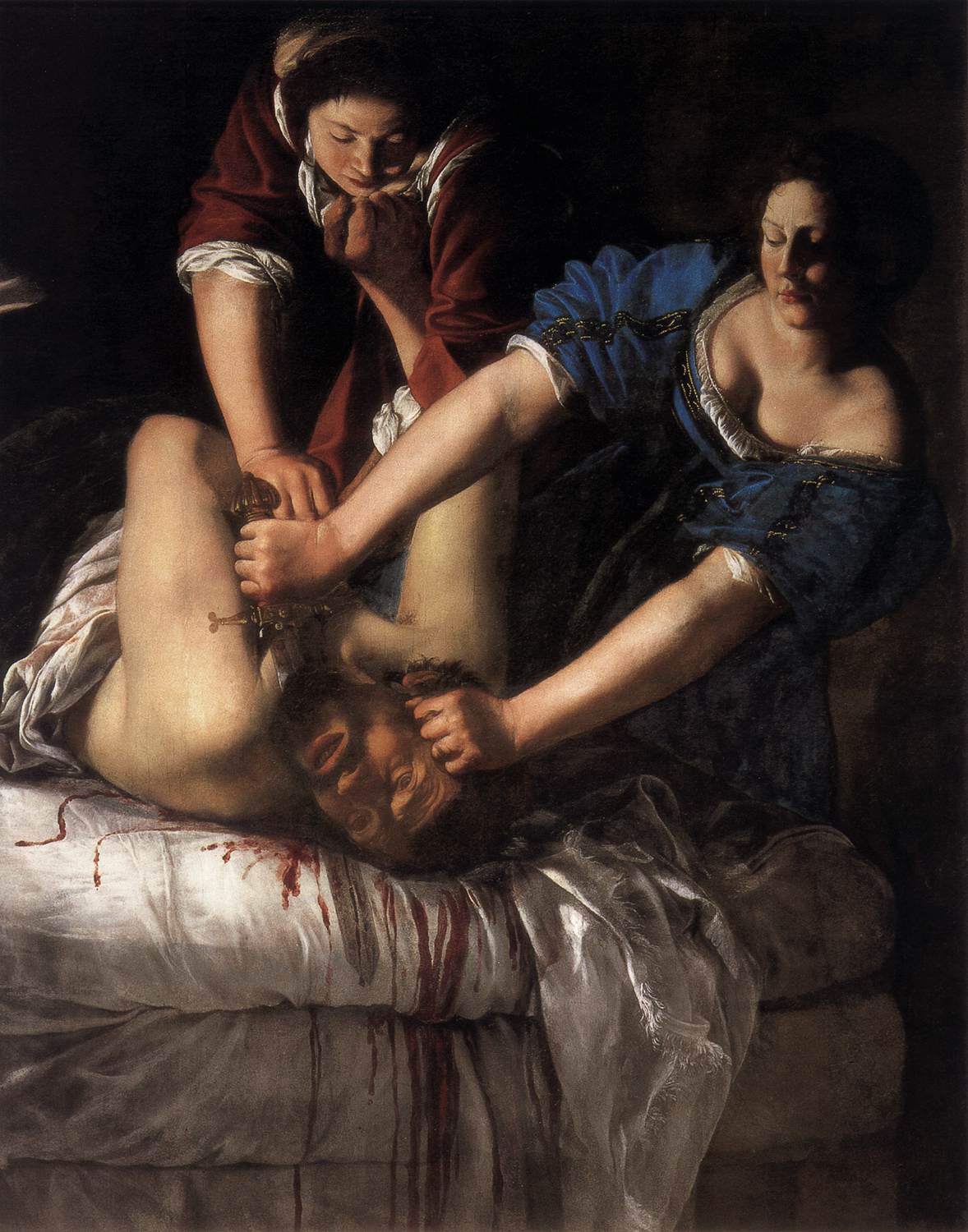
The artist I have identified for this mini-post is Artemisia Gentileschi, an Italian Baroque painter who was born in the late sixteenth century. She was the daughter of Orazio Gentileschi, a famous Italian Baroque painter. The two were heavily influenced by Caravaggio, considerably the more famous of the aforementioned Italian Baroque artists. Caravaggio was best known for his utilization of dramatic lighting in his works. This technique carried into the Gentileschi household and their works that have lived well into the modern age, particularly Artemisia's Judith Slaying Holofernes, which has been heavily compared to Caravaggio's David with the Head of Goliath. Artemisia, much like Caravaggio, painted very dramatic Biblical scenes. These three artists strengthed their craft throughout the Italian Renaissance, producing some of the most recognizable works of today.

Artemisia Gentileschi - Judith Beheading Holofernes - WGA8563.jpg
Artemisia Gentileschi, Judith Slaying Holofernes, 1620-21.


Artemisia's father recognized her strengths as an artist and wanted to find someone to help her refine her talent, which is why he enlisted the help of his friend and fellow painter, Agostino Tassi. Rather than mentoring the young Artemisia, Tassi savagely raped the young woman and only stopped after Artemisia defended herself by ripping off a piece of his flesh with her bare hands. The Gentileschi's took Tassi to the Papal court for his crimes to save Artemisia's reputation. While the grotesque details of what Tassi had done outside of this animalistic act began to emerge (i.e., cheated on his wife with his sister-in-law and was even planning to murder his spouse), the court and the public became much more focused on Artemisia and her place in society. Artemisia's reputation underwent considerable scrutiny and she was even tortured in an attempt to ensure that she was telling the truth for this case.

I had seen Judith Slaying Holofernes in an Art History class back in high school and had always been infatuated with how a woman at this time period could have produced something as realistic and violent as what Artemisia had created. The blood and scene itself are much more intense than what her male counterparts (i.e., Caravaggio) have produced. However, I am now aware of the passion that she had poured into creating this particular, vivid painting and have a better understanding of her creativity. I believe that this particular painting, the Biblical scene it represents, and even Artemisia's story has aged in such a distinctive way.

We find ourselves in the midst of the #MeToo movement, which has focused on the experiences of sexual violence survivors and given victims the strength to stand up against their abusers. I believe that Artemisia and her story resonate with many of the stories that have been brought to the light in growing numbers over the course of the last couple of years. Many men in Hollywood and in other areas (particularly in the entertainment industry) have utilized their place and power to manipulate and take advantage of women, much like what unfolded between Artemisia and her assaulter. These women have at times seen these men as mentors, teachers, colleagues, friends, and so forth only to be betrayed to the most despicable extent by them. One of the accounts that have remained with me throughout the growth of the #MeToo movement is that of Professor Christine Blasey Ford, who was sexually assaulted in high school by Brett Kavanaugh, who was nominated to serve the U.S. Supreme Court in the summer of 2018. The Senate's hearing on the accusations surrounding Kavanaugh's actions was televised and I clearly remember the backlash Blasey faced whilst testifying against her assaulter. Much like Artemisia, Blasey's reputation found itself on the line throughout this testimony, although they were both victims in their situations.

https://www.britannica.com/biography/Artemisia-Gentileschi


Mini Post #1 - Zanele Muholi


I  chose to highlight Zanele Muholi, a black South African lesbian/ non-binary visual artist and photographer. Their work focuses on documenting LGBTQIA+  black people in South Africa to show and express the lives of these people in an African nation full of homophobia and discrimination against them. Deeper than that, part of their mission through their artwork is to reconstruct/recreate the visual histories of LGBTQIA+ people in South Africa because for so they have been full of heartbreaking narratives about the experiences they grow through. Their stories and pieces go beyond the resistance and existence of homophobia, hate crimes, and discrimination rather they bring to life the beauty that does not frequently get shown. Their work is full of positive imagery and storytelling however it does not shy away from the true struggle they are forced to endure. 

Zanele Muholi, Eva Mofokeng, Somizy Sincwala, and Katiso Kgope, Parktown, 2014

One of their most prominent and still ongoing projects “Faces and Phases” started in 2006. Although same-sex marriage was legal in South African by 2005, they chose to start this piece because of the discrimination and violence against black queer and trans women whose fight for equality still persists even within that. The piece above speaks to the beauty of black trans women. Often times the visual history we have of trans women involves mourning the death and killing of these them however, this piece shows another side. That being a woman is not defined by a particular body type. The hands specifically placed on their chest presents a juxtaposition or dichotomy, drawing attention, but also from that area. She is inherently critiquing how we look at the female body, but also bringing to light that it should not be central to defining womanness. 


ZANELE MUHOLI, “Bona, Charlottesville,” 2015. 

 Another project they recently came out with, Somnyana Ngonyama “Hail the Dark Lioness” is a series of herself as the photographer but also the muse. The series serves to tackle a variety of issues, but one trend throughout all the work is the darkness of the photos. She was very purposeful in doing so to show acceptance and love of their dark skin and blackness because historically and presently it is not always deemed as beautiful. The dark tones allow them and other people to reclaim their blackness through the artistry. 


April Greiman

April Greiman is an American designer who is known to be one of the first ones to embrace a computer technology. Greiman calls herself a "trans media artist" expanding the definition and challenges the stigma about being just a designer, but rather a multidisciplinary creator. She taught at CalArts after she was invited to educate there, exploring different media and graphic design. April Greiman is known for her curiosity and fascination with the developing technologies and a world around her in general, so naturally she became interested in the computer graphics that was just getting started at that time.

In her poster "Design Quarterly, n133. Does it make sense" she uses technology and tools around her to create work that reflects her identity. Her experimentation and willingness to work with technology, using it in her own means shows her desire to challenge and expand the means of design. The bitmap poster represents her dual identity and captures attention not only with its big scale, but also with her ability to find flexibility and beauty in pixels and being able to use that in her unique way. By just using pixels as her tool, she creates a powerful yet vulnerable piece that reveals her not only as a designer but also as a woman to the viewer, openly showing herself.

Here is a link to read more about her life and accomplishments as a designer and artist:
https://www.aiga.org/medalist-aprilgreiman

Inspiration Artist: Barbara Kruger


Steven Velez
January 27, 2020

Barbara Kruger is an American conceptual artist born on January 26, 1945 in Newark, NJ. Kruger incorporates image and text to help deliver her sexual, social, and political messages. Kruger is huge advocate of exploring gender and identity. Often times her artwork challenges the stereotypes created by the mass media about gender roles, social relationships, and political issues.

In one of her famous works (Your body is a battleground, 1989), Kruger addresses political and media issues especially the protest of the antiabortion laws. This art was created in support of reproductive freedom for the Women’s March on Washington. In many of her works, Kruger tends to keep the images in black and white scale with her slogans over the images.