"Contemporary art refers to art—namely, painting, sculpture, photography, installation, performance, and video art" (Abdou). It was once a motion that portrayed many artwork subunits like—pop art, which was once the response to current artwork its fundamental purpose of painting mass culture. Installation artwork is 3-dimensional constructions that seriously change the surroundings and viewpoint of the viewer. Street artwork is the latest contemporary artwork movement. It grew to be recognized with the aid of the use of graffiti frequently utilized for social activism. Five contemporary artists I chose are Barbara Kruger, Ana Mendieta, Yayoi Kusama, Marina Abramović, Kiki Smith.
Yayoi Kusama is an artist from Japan that has contributed to the movement of contemporary art. She is extensively identified for her regular use of polka dots and infinity installations. Kusama's uniqueness of using dots in her paintings, which shaped her career, was derived from hallucinations she once had. Her "infinity net" artwork was different in a way as it disregarded the ends of the canvas and would go over them to make it seem as if the art was going to infinity. The unending marks create a different feel to the viewer as if they are in a hypnotic state. Her paintings came to be after the Minimalist movement. Over time her pictures turned into Pop and Performance art. The painting, known as Infinity Mirror Room-Phalli's Field (1962) by Yayoi, is "a mirrored room whose floors were covered with hundreds of stuffed phalli that had been painted with red dots" (Cole).
 |
Yayoi Kusama, Infinity Mirror
Room-Phalli’s Field, 1962
|
"Ana Mendieta was a key figure in the Body art movement that emerged from the Performance art movement" (Art Story). By using the nude physique, Mendieta can depict the present and what is real. A key component of her work is the absence, which separates the real world from the fantasy world people believe in. She shows what people look like with flaws and all and not things men want on women. She is critical to Land art, motion between the relationship of panorama and architecture. The setting of her work was more in a natural environment, which can be seen in her work. One instance of her earthworks is referred to as the Siluetas.
 |
| Ana Mendieta, Siluetas, 1978. |
Barbara Kruger is an American artist known for her ability to change pictures and texts through photos. She is viewed as a conceptual pop artist because of her ability to manipulate things. Kruger stopped working on art by hand and began to use her information on graphic design to portray her art. Kruger's artwork critiqued problems that had to do with feminist, social, and political. She also disagreed with the idea of the Male Gaze, which she criticized. with one of her works. One of her well-known works is Untitled (Your Gaze Hits the Side of My Face (1981), which criticized the Male Gaze.
 |
| Barbara Kruger, Untitled (Your Gaze Hits the Side of My Face, 1981 |
Kiki Smith is an American artist famous for her visceral and nasty artworks that are existing the human physique in incredible detail. Smith's artwork was created through the ideas of Minimalism. She paved a way inside Feminist art, and she revealed her thoughts through visceral symbols of guys and women, in addition to specific parts. One of her famous works, known as Lilith, has her stuck to a wall above the audience's head. Lilith is believed to have once been the first spouse of Adam before Eve. Lilith wanted to have the same equality and power as Adam in which he disagreed, causing Lilith to be sent to hell. Because of all the Lilith grew to become an image of female rebellion.
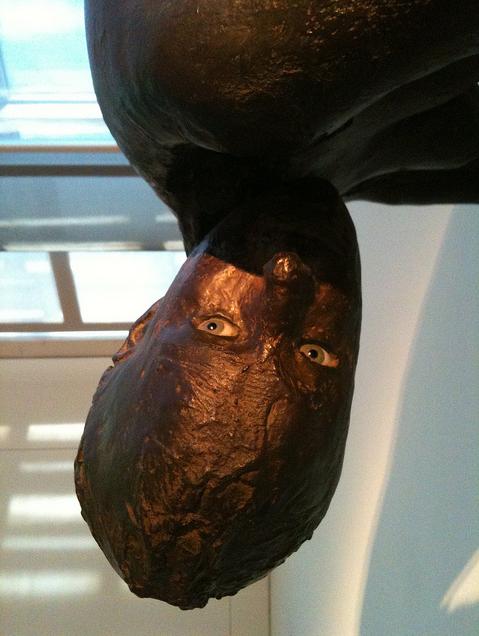 |
| Kiki Smith, Lilith, 1994 |
Marina Abramović, originally from Yugoslavia and who later moved to Serbia, challenged the limits and energy of her physique and mind. Her performances have been regarded as a ritual pressure in the 1960s. She regularly put herself in a role of danger, in concerts that have been each prolonged and painful. Unlike an ordinary artist, Marina's artwork was not done on a standard canvas, but instead, she used her body as a canvas. One of her works, known as The House with the Ocean View, is a piece where she spent twelve days at the Sean Kelly Gallery in a position unable to speak, eat, or write. She was once contained inside three rooms constructed six feet off the floor, and she only was able to sleep, drink water, use the bathroom, shower, and watch the audience.
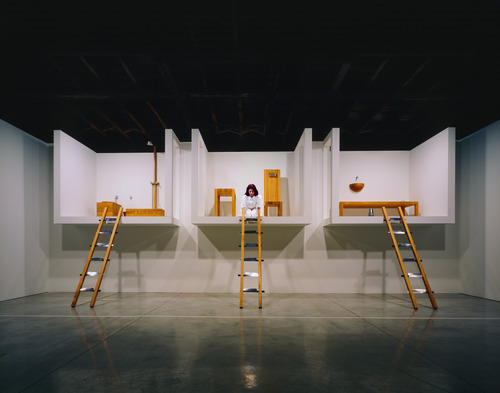 |
| Marina Ambramović, The House with the Ocean View, 2002 |

No comments:
Post a Comment