Jasdip Kaur
Professor Cacoilo
Art and Women
April 23, 2020
Women Empowerment & Feminism
For many years, art has been a form of not only visualization, but a form to express emotion, feelings and most importantly, a story. Some consider music their source of expression, while others consider art. There have been many artists who have created work that displays women empowerment. Women empowerment art is another incredible tool for supporting women globally. While some stand firm on worldwide tribunes, numerous artists advance the possibility of women's liberation and empower women through their artwork along with feminism.
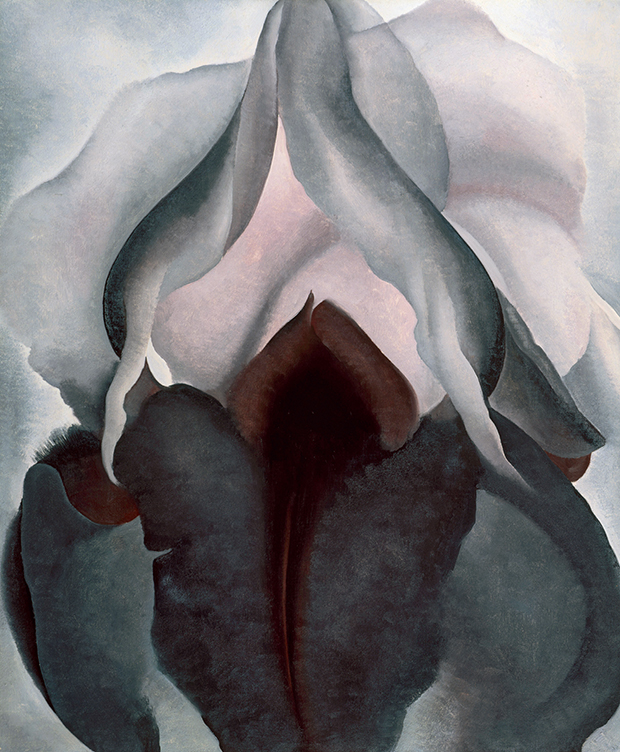 |
| Black Iris III, 1926 Georgia O'Keeffe |
Georgia O'Keeffe, born November 15, 1887 in Sun Prairie, WI, was an American artist who was known popularly for her painting of enlarged flowers. Throughout O’Keeffe’s career in painting, she had resisted the sexual concepts into her paintings, which began in the 1920s. However, she was then revived by feminists in the 1970s who took her work as a statement of female empowerment. As O’Keeffe’s motive was to paint flowers, within those flowers were veiled a representation of feminism. For instance, in O’Keeffe’s, Black Iris III, there was a female genitalia while also accurately depicting the center of an iris. O’Keeffe’s flower paintings were the exploration of the female body, something that many women during that time were very proud to claim, their body and their gender. Being in time of male domination and a society where gender was important, especially the major gender, O’Keeffe found interest in the art world, leading her interest into flowers: a symbolism of femininity, love and sexuality. Her flower paintings were her approach to a sexual element.
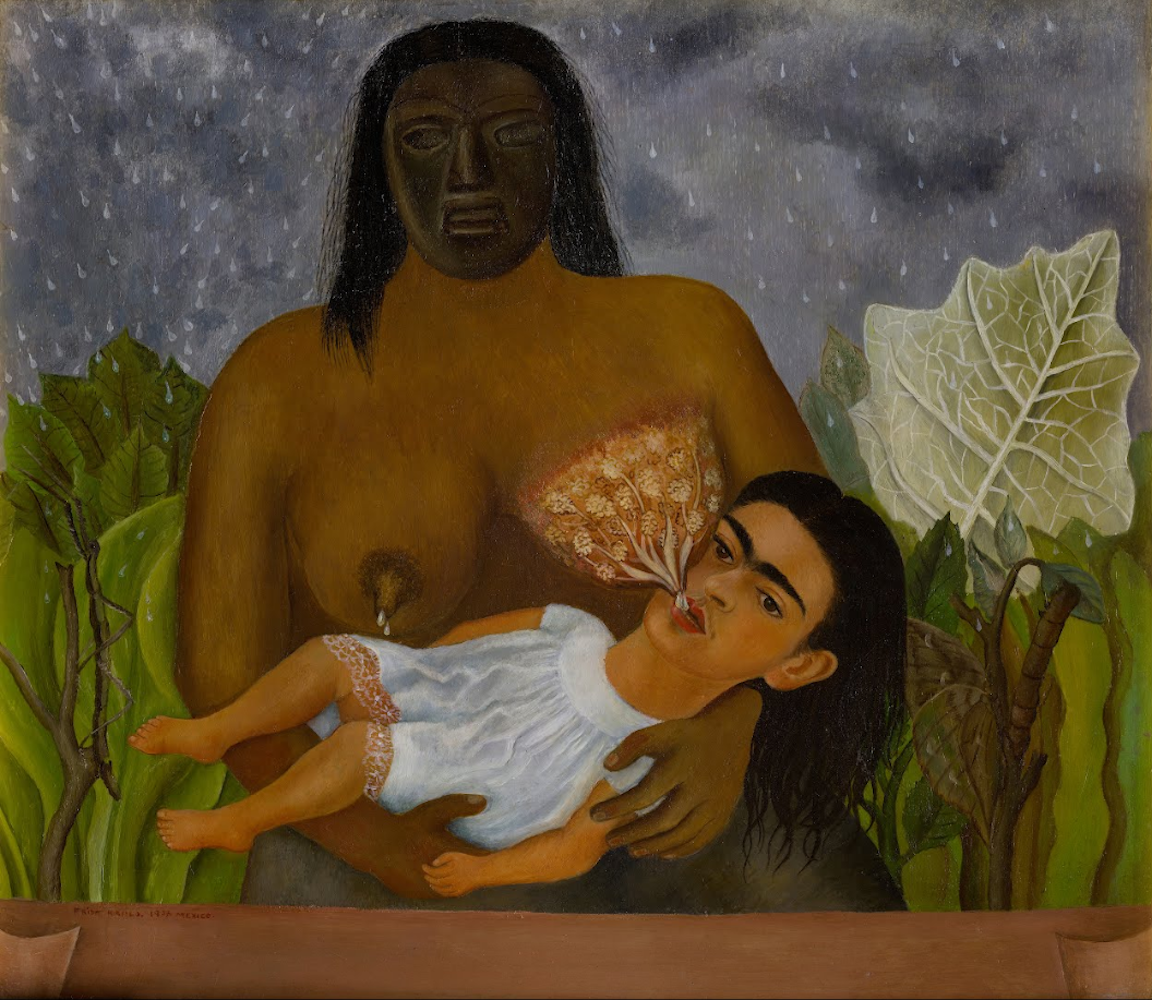 |
| My Nurse and I, 1937 Frida Kahlo |
Frida Kahlo, born July 6, 1907 in Coyoacán, Mexico City, Mexico, was a Mexican painter known for her very famous self-portraits inspired by popular culture, identity, gender, class and so on. Although Kahlo contributes into the art industry just like every other artist, she had her own position and stand in the art industry during her time. Her religion of character goes with her artwork in making a legacy of female power that has spread over a long way time. Kahlo spoke to an intricate rendition of femininity that stirred things up of female public presence, and she did this in two fundamental manners. Primarily through her art, a lot of which is explicitly and proudly feminine in nature, and addresses striking and now and then difficult female themes that, until Kahlo's brave depiction, were not straightforwardly examined. The second manner by which Kahlo drew in with this disparate brand of feminine articulation was through her appearance, indicated over and over in both photographs and her own masterful portrayals of herself. These methods of articulation consolidated to make the solid and shameless female presentation that has gotten fundamental to Kahlo's religion of character. One art piece of many that depicted feminism and even women empowerment was her artwork, “My Nurse and I” (1937). Kahlo depicts female biology and the female practice of breastfeeding very straightforwardly, even presenting the breasts of the Mexican wet-nurse in such a way as to show details of the milk ducts and mammary glands.
 |
| The Blue Room, 1923 Suzanne Valadon |
Suzanne Valadon, born September 23, 1865 in Bessines-sur-Gartempe, France, was a French painter and artist who displayed feminism and women empowerment in her work through the concept of nudity. She tested the concepts of nudity and carved another basic space wherein to think about a lady's body. Valadon's work depended on genuine feelings and real physical experience, urging women to search for themselves and to recover their own perspective. In order to achieve the work she has provided for us today, she had to define her own identity by going outside of the norms. Throughout history, women have always been a part of the male gaze and patriarchy. They have always been assumed to follow norms in order to convey male gaze with the usage of their bodies. Valadon's work has been a source to empower women to be comfortable with their bodies and embracing the beautiful reality that each woman possesses. Which is exactly why in today’s society, we have women who are petite, plus size, and more; however, everyone is classified as beautiful as we accept our body today. Although some are comfortable with their bodies today, the expectations from men on how a woman's body should be are still existent.
 |
| Self-portrait at 6th wedding anniversary, 1906 Paula Modersohn-Becker |
Paula Modersohn-Becker, born February 8, 1876 in Friedrichstadt, Dresden, Germany, was a German painter who was also known as the first known female painter to paint nude self-portraits. Not only did she paint nude self-portraits, but she also incorporated a pregnant nude portrait, something that was not done before. In the article from Lenny, Radycki suggests that, if Paula is responsible for the modern origin of the female gaze, it was as much a calculated statement — a way into the competitive arena of big-name painters — as a personal sentiment about the humanity of the women she portrayed. She displayed expressionism through her work along with women empowerment and feminism through the visualization of her body.
There have been many artists in history that have created a legend with their artwork with the theme of feminism and women empowerment. They all left a great trademark in the art industry, that still lives today. However, there are artists in today’s society that continue to work with the idea of women empowerment and feminism. Contemporary artist, Angela Fraleigh, is known for her oil and mixed media paintings where it is shown a huge collaboration of femininity, sexuality along with the perception of the artist towards gender roles. According to Fraleigh herself states, “I weave together realism and abstraction in lush and complex works, ranging from intimate portraits to monumental figure paintings that reimagine women’s roles in art history, literature, and contemporary media.” Within the culture of feminist art, Fraleigh continues the nude culture of art with her oil based nude women paintings.
 |
| Startling, evanescent, thrilling: Angela Fraleigh’s 2019 ‘Fold in the sun.’ |
Citations:
“About.” ANGELA FRALEIGH, www.angelafraleigh.com/process.
Bosson, Julia. “The Mother of the Female Gaze.” Lenny Letter, www.lennyletter.com/story/female-gaze-artist-paula-modersohn-becker.
Chadwick, Whitney. Women, Art, and Society. Thames Hudson Ltd, 2020.
Ellis-Petersen, Hannah. “Flowers or Vaginas? Georgia O'Keeffe Tate Show to Challenge Sexual Cliches.” The Guardian, Guardian News and Media, 1 Mar. 2016, www.theguardian.com/artanddesign/2016/mar/01/georgia-okeeffe-show-at-tate-modern-to-challenge-outdated-views-of-artist.
“Frida Kahlo and Women's Empowerment.” Kahlo in Color, 14 Dec. 2017, kahloincolor.wordpress.com/frida-kahlo-and-womens-empowerment/.

No comments:
Post a Comment