Another major influence was the idea of religion. If women did not want to become house labor, they were able to become nuns. Many women preferred to join the church and some, “joining a convent freed woman from the demanding roles of being wives and mothers” (Guerilla Girls 21). By joining the church, women “ social roles remained circumscribed by a Christian ethic that stressed obedience and chasity” (Chadwick, 44). Women were also controlled by the church, meaning that the church told them what they were allowed what to learn. But by joining the church it allowed some women to learn to read and write, “nuns wrote book on medicine, science, and sacred music” (Guerilla Girls 22). During the Middle Ages, women were either controlled by men or by religion. They were unable to ever feel free.
After the Renaissance period, it was better for women compared to the Middle Ages. Women started to gain more control and freedom. Religion influenced most of the artwork during this period. Women challenged the social norms by removing themselves from men. Some women artists were unable to join the painter's guides or academics. Even if they helped make the painting they were not recognized. Having wealth was very valuable, especially for women. Women artists who were born into a noble family were given better opportunities than other women. Education was provided to women who were usually rich or came from elite families. In the text by Chadwick he illustrates, “the greatest period of female social progress in history” (177). An example of this was Sofonisba Anguissola, who was born into a noble family. Her father wanted her to become educated and this benefited her in the long run. Besides getting her educated, her father sent her drawings and paintings to Michelangelo. Without Anguissola’s noble statues, this would never happen to her. Below is a Self-Portrait created by Sofonisba Anguissola to reflect the self-representation of her artwork.
 |
| Sofonisba Anguissola, Self Portrait, 1561 |
Another idea that was presented during the Renaissance period is that women artists started to focus on women's empowerment. Women artists started to paint women with a more powerful persona. A famous painter that expressed this idea was Elisabetta Sirani. She is known for her painting of Portia Wounding Her Thigh. In the painting, Sirani is represented that women are capable of acting and not cased away in the shadow. Her artwork Portia holds the power in the painting and conveys her strength through her pose while she is wounding herself. “Portia has to prove herself virtuous and worthy of political trust by separating herself from the rest of her sex” (Chadwick, 101). Portia is separating herself from everyone else in the background to symbolize her bravery and how is strong to cut herself. This shows how much women have to sacrifice to be taken seriously. Sirani wanted to represent Portia as an empowering woman who is not afraid to retaliate and hurt herself. Renaissance artwork was used to show the stories of women more than Middle Age artists because they had more freedom during this time.
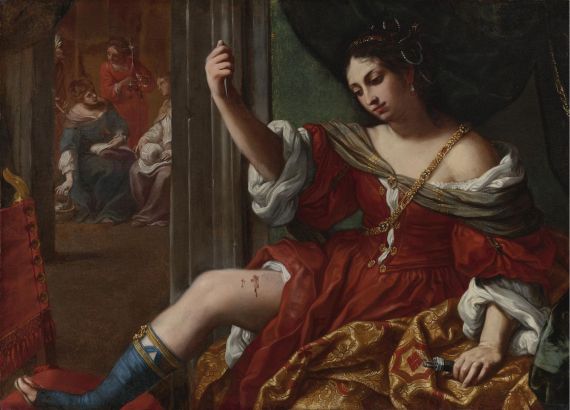 |
| Portia Wounding Her Thigh, Elisabetta Sirani, 1664 |
During the 19th century, women began to use a more creative way to illustrate artwork. They began to sculpt, photograph and quilt. Harris Hosmer was known for being the first professional woman sculptor. She was an American sculptor, who traveled to Italy to share the idea of neoclassicism. Her famous marble sculpture is Zenobia in Chains. Zenobia is in a drape and is putting all of her weight on one leg which gives the illusion that she is moving or walking. It symbolizes struggling women in a patriarchal society. Women grew an interest in learning photography. Photography was something new to women that they were trying to expose themselves to.
 |
| Harriet Hosmer, "Zenobia in Chains", 1859 |
Women were trying to prove themselves through their artwork. The technology was starting to develop and helped women take charge of their rights. This allowed Harriet Powers to become known. Her artwork was not meant to be displayed as art but as a means to support her family after her husband passed away. With her craftsmanship and creativity, she was able to quilt and use needlework. She was illiterate but was able to memorize stories from the bible and create quilts.
 |
| Harriet Powers, Pictorial Quilt, 1895 |
The lives of women changed throughout the Middle Ages to the 19th century. The strive for women wanting equality became evident. There is still divided between men and women in the art industry, but the roles have changed. Women are now able to express themselves and are not forced to hide behind men throughout history. Artists were able to become recognized and celebrated for their accomplishments. There will always be a struggle against women to feel fully free but much more progress to be made.
Work Cited:
The Guerrilla Girls’ Bedside Companion of the History of Western Art, Penguin Books, 1998.
Chadwick, Whitney. “Women, Art, And Society,” Fourth Edition. World of Art. 2007.

No comments:
Post a Comment