Here is an ongoing list of sources you can read during this time. Most important is to look to experts, scientists, journalists and leaders who concentrate on facts. Information is changing quickly and laws and protocol are also changing quickly. Stay as calm as possible but read reputable sources as much as possible. You can broaden this diet with politicians, authors and academics that you also trust.
This is a list to get you started. You can choose to follow these sources on twitter and/or go directly to their websites. Many of these sources have paywalls but allow you to view some content for free. Scroll down past the paywall warnings to read the news even if you do not subscribe.
I will keep adding to this list. *Please leave comments below with other sources you would like me to add and comments in general.
Health and Pandemic information:
CDC - Centers for Disease Control and Prevention https://www.cdc.gov/
WHO - World Health Organization https://www.who.int/
Journalism:
The New York Times
The Wall Street Journal
The Washington Post
BBC
PBS
WNYC
National Public Radio
The Economist
The New Yorker
Wire Services: The Associated Press, Reuters, Bloomberg News
The Atlantic
Politico
Time Magazine
Los Angeles Times
USA Today
Sunday, March 22, 2020

Wednesday, March 4, 2020
Post 2
Misano Ishida
Professor Cacoilo
Art and Women
February 19, 2020
Post 2: Due Thur. Feb. 27
Gender Roles, Subject and Power
My research on female artistic
persons and artists between the Middle Ages around 500 A.D. and Impressionism in the 1900s are to trace what they tried to change the world. Men made most societies
created in the past - consequently, everything enacted in men’s favor. Gender
inequalities arose because women were given positions to assist men - women’s
rights as citizens recognized for hundreds of years until the 1900s.
In the Middle Ages (476-1453), under
the patriarchy of Europe, women had to have children, do housework, and raise
children. Women were discriminated against for the reason they were physically
inferior to men. Art historian Whitney Chadwick says, "Access to education
and Covent, the center of women's intellectual and artistic lives from the 6th
to the 16th century, was often determined by the noble birth" (45). His
statement defined that most women had no chance educated because many people
then were peasants, and women’s statues were belonging to their fathers or
husbands. Some nuns made miniatures of the church, but generally, women were
forbidden to become independent artists, so their names were not left. Instead,
in the art of the Bible, what was drawn was more critical. Being an artist was
a limited job for men at the time.
(Image
1: Unknown, Peasant Woman Milking a Cow, 13th Century)
Peasant Woman Milking a Cow by an unknown painter, shows a
woman doing a job that is neither easy nor clean. She must stay outside or in
the barn to keep the same posture while getting milk. Her husband is probably
going out to get cash and sell milk or trade for something else that means a
higher level of work. In this era, it was thought that women could not be as
intelligent as men.
The
Renaissance (1300-1600) gave men the opportunity for wealth from the
development of capitalism and colonialization, not including women. This phenomenon
for women was seen more in the suburbs where social discipline and rules were
less strict than in large cities. Italian-born female painter Sofinisva
Anguissola (c. 1532-1625) was fortunate enough to live in a small town with an
understanding father. Most women could not read or write in this era. Artistic
women were forced to work to help for male artists. In most cases, women were
not yet allowed to leave their names as artists.
(Image 2: Sofonisba Anguissola, Self-Portrait
with Bernardino Campi, 1556)
Sofonisba Angissola's Self-portrait with Bernardino Campi (Image
3) shows her challenge by placing herself in the center of the artwork, which
means the most important person in the painting. It also reflects her pride,
confidence, and desire to live as an independent female artist in a
male-dominated world in all fields, including the art business.
The
17th and 18th centuries (1601-1799) were the days when the Royal Academy ruled
British, French, and Italian artists. Neoclassicism, which drew Greek and
Roman mythology was the primary trend in depiction, but women were banned from
attending school. In contrast, in the Netherlands, the daily life of painting
was more important than creating artwork for the wealthy class. Although women
were banned from the use of male nudity, instead, they painted indoors with
their families and daily objects. As a result, what they produced was
still-life paintings, and it was the beginning of impressionism.
(Image 3: Judith Leyster, The Proposition,
1631)
Judith Reyster's The Proposition shows her strong will to overcome temptation. The appearance of
the walls, how to make hair, the time to spend for sewing will introduce her
class to work as a farmer. The social status of a man seen from his fur hat and
clothes indicates a high level, but his attitude of offering to pay her for the
exchange for satisfying his sexual desire is not appropriate. In this painting,
she tries to teach morals and ethics to viewers so as not to be dominated by
abundance or social power.
Victorian England (1837-1901) was a transitional period in which
the people gained abundance, and the monarchs began to decline. Industrial
capitalism helped working-class people achieve stable work and high incomes,
including women. Also, the Western social movement influenced the economic
independence of middle-class and upper-class women by gaining a career in the
arts. Many middle-class people were able to access a culture where they could
buy artworks. Economic growth pressured husbands with low income, so they
needed another income resource from their wives. This situation raised women to
get a career. In this era, many women entered the school, and the status of
women increased.
(Image
4: Edith Hayllar, Feeding the Swans, 1889)
Feeding the Swans by Edith Hayler's depicts women’s
social system for generations. A house with pillars shows the wealth and
protection of the family. All the females in the painting look happy. However,
they are not free, and each has an obligation. The small child must be trained,
and a young woman needs to marry a man to bring wealth to her family. The
mother is required to raise her children to meet the best partner, and
grandmother is responsible for watching over the whole family to maintain the
cluster. Marriage is a financial deal for the entire family in this era.
For the American Craft era
(1801-1900), immigrants were required to work hard to develop the new land, and
women had a responsibility to help their husbands. While women stayed home,
they created such as paintings, sculptors, needlework, quilts, woodwork, so
that they earned money from home. Enslaved people were accepted as chattel
until emancipation. Those slaves were prohibited from being educated. Instead,
they learned how to create life goods as a hobby. The quilts made by such
individuals contain their historical facts as a victim of slavery. The
Guerrilla girls commented “Why don’t we know more about them? (55)” about the African
American motifs because they were first introduced by Picasso and Matisse, not an
actual creator such as Harriet Powers.
(Image
5: Harriet Powers, Pictorial Quilt, 1888-1895)
Powers’ Pictorial Quilt has many stories
involved the enslaved African Americans that are not in books while they are
bounded to work for free for the lifetime. They spend their time on craft
instead of enjoying free time like having leisure. Picturing their lives and
past events is what they enjoy since they are illiterate. The views of people
owned properties in America on the matters indicated on the quilt are different
from what it tells.
During Impressionism (1870-1880), women tried to gain social rights, while the
skills of such artists flourished. The Philadelphia Centennial Expo in 1876 was
an example of gender discrimination for women to confront. Female artists made
only 10 percent of the exhibitions, and this fact motivated them to become
social activists. Impressionism was artworks created to depict such as family
time and everyday matters. Female artists opened the door to the public to
enjoy culture, and as a result, more works were sold to people. Not only that,
they developed their way of expressing their opinions on the canvas in this
era.
(Image 6: Emily Mary Osborn, Nameless and Friendless, 1857)
Emily Mary Osborn’s Nameless and Friendless shows how the
woman in the art gallery is vulnerable. The color of her clothes tells her that
she is a widow. She looks down and seems depressing or feel a shame to sell the
painting. Her finger is twisting the ribbons from the dress, expressing her
fear. The two men in silk hats stair at her and the young man on the ladder is
curiously taking at the painting that she tries to sell. The store worker or
the owner is perceiving how the item is invaluable. The reactions that those
men surrounding the lady are all negative.
From the fifth century to the eighteenth century, artistic females struggled because
they were banned from working as artists, which was unfair to them. Using
artworks, they tried to amend the norms, rules, and regulations to spread their
opinions. After their attempts for hundreds of years, they were admitted to art
schools and were able to be independent and work as artists. By doing this
research, I gained my knowledge that each painting contains the creators’
belief.
Notes
Chadwick,
Whitney. Women, Art, and Society. Thames & Hudson world of art, 2012 (45l).
Guerrilla Girls.
Harriet Powers: Sew, Sew Modern. Chapter 5. The 19th Century: Girls
Going Places. (55)
Image 1: Unknown. Illustration in a Bodleian Library manuscript Ms 764, f. 41v., (Peasant
Medieval Woman Milking a Cow), England. 13th Century.
Black and white image - Chadwick,
Whitney. Women, Art, and Society. Thames & Hudson world of art, 2012 (42)
Colored image (Peasant Medieval Women Milks a Cow) - http://www.medievalchronicles.com/medieval-people/medieval-women/medieval-women-milking-cow/
Image 2: Sofonisba
Anguissola. Self-Portrait with Bernadino Campi, 1556.
Image 3: Judith Leyster. The Proposition, 1631.
Image 4: Edith Hayllar. Feeding
the Swans, 1889.
Image 5: Pictorial Quilt, 1888-1895.
Museum of Fine Art in Boston,
Massachusetts.
Image 6: Emily Mary Osborn’s Nameless
and Friendless, 1857.
Monday, March 2, 2020
Post 2
During the Middle Ages, women were forced to obey the gender roles that were assigned from their community. Women were “the virtual prisoners of the men in their lives” (Guerrilla Girls 19). There were prohibited to read or write and their opinions did not matter. Women faced many restrictions. They are expected to play the “role” of wife or mother. Women were expected to take care of children and obey their husband's commands. Women don't have a choice in what they want to do; they are forced to obey and please the men in their lives. They, “…were usually engaged to be married at age 12 and were married by 15. If an engaged girl married another man, she could be killed” (Guerrilla Girls, 22). Education wasn’t even an option because they were married off so young preventing them from ever becoming literate. Women were harmed if they disrespected or disobeyed their husbands which are by most women tried to follow their orders.
Another major influence was the idea of religion. If women did not want to become house labor, they were able to become nuns. Many women preferred to join the church and some, “joining a convent freed woman from the demanding roles of being wives and mothers” (Guerilla Girls 21). By joining the church, women “ social roles remained circumscribed by a Christian ethic that stressed obedience and chasity” (Chadwick, 44). Women were also controlled by the church, meaning that the church told them what they were allowed what to learn. But by joining the church it allowed some women to learn to read and write, “nuns wrote book on medicine, science, and sacred music” (Guerilla Girls 22). During the Middle Ages, women were either controlled by men or by religion. They were unable to ever feel free.
After the Renaissance period, it was better for women compared to the Middle Ages. Women started to gain more control and freedom. Religion influenced most of the artwork during this period. Women challenged the social norms by removing themselves from men. Some women artists were unable to join the painter's guides or academics. Even if they helped make the painting they were not recognized. Having wealth was very valuable, especially for women. Women artists who were born into a noble family were given better opportunities than other women. Education was provided to women who were usually rich or came from elite families. In the text by Chadwick he illustrates, “the greatest period of female social progress in history” (177). An example of this was Sofonisba Anguissola, who was born into a noble family. Her father wanted her to become educated and this benefited her in the long run. Besides getting her educated, her father sent her drawings and paintings to Michelangelo. Without Anguissola’s noble statues, this would never happen to her. Below is a Self-Portrait created by Sofonisba Anguissola to reflect the self-representation of her artwork.
Another idea that was presented during the Renaissance period is that women artists started to focus on women's empowerment. Women artists started to paint women with a more powerful persona. A famous painter that expressed this idea was Elisabetta Sirani. She is known for her painting of Portia Wounding Her Thigh. In the painting, Sirani is represented that women are capable of acting and not cased away in the shadow. Her artwork Portia holds the power in the painting and conveys her strength through her pose while she is wounding herself. “Portia has to prove herself virtuous and worthy of political trust by separating herself from the rest of her sex” (Chadwick, 101). Portia is separating herself from everyone else in the background to symbolize her bravery and how is strong to cut herself. This shows how much women have to sacrifice to be taken seriously. Sirani wanted to represent Portia as an empowering woman who is not afraid to retaliate and hurt herself. Renaissance artwork was used to show the stories of women more than Middle Age artists because they had more freedom during this time.
During the 19th century, women began to use a more creative way to illustrate artwork. They began to sculpt, photograph and quilt. Harris Hosmer was known for being the first professional woman sculptor. She was an American sculptor, who traveled to Italy to share the idea of neoclassicism. Her famous marble sculpture is Zenobia in Chains. Zenobia is in a drape and is putting all of her weight on one leg which gives the illusion that she is moving or walking. It symbolizes struggling women in a patriarchal society. Women grew an interest in learning photography. Photography was something new to women that they were trying to expose themselves to.
Women were trying to prove themselves through their artwork. The technology was starting to develop and helped women take charge of their rights. This allowed Harriet Powers to become known. Her artwork was not meant to be displayed as art but as a means to support her family after her husband passed away. With her craftsmanship and creativity, she was able to quilt and use needlework. She was illiterate but was able to memorize stories from the bible and create quilts.
The lives of women changed throughout the Middle Ages to the 19th century. The strive for women wanting equality became evident. There is still divided between men and women in the art industry, but the roles have changed. Women are now able to express themselves and are not forced to hide behind men throughout history. Artists were able to become recognized and celebrated for their accomplishments. There will always be a struggle against women to feel fully free but much more progress to be made.
Work Cited:
The Guerrilla Girls’ Bedside Companion of the History of Western Art, Penguin Books, 1998.
Chadwick, Whitney. “Women, Art, And Society,” Fourth Edition. World of Art. 2007.
Another major influence was the idea of religion. If women did not want to become house labor, they were able to become nuns. Many women preferred to join the church and some, “joining a convent freed woman from the demanding roles of being wives and mothers” (Guerilla Girls 21). By joining the church, women “ social roles remained circumscribed by a Christian ethic that stressed obedience and chasity” (Chadwick, 44). Women were also controlled by the church, meaning that the church told them what they were allowed what to learn. But by joining the church it allowed some women to learn to read and write, “nuns wrote book on medicine, science, and sacred music” (Guerilla Girls 22). During the Middle Ages, women were either controlled by men or by religion. They were unable to ever feel free.
After the Renaissance period, it was better for women compared to the Middle Ages. Women started to gain more control and freedom. Religion influenced most of the artwork during this period. Women challenged the social norms by removing themselves from men. Some women artists were unable to join the painter's guides or academics. Even if they helped make the painting they were not recognized. Having wealth was very valuable, especially for women. Women artists who were born into a noble family were given better opportunities than other women. Education was provided to women who were usually rich or came from elite families. In the text by Chadwick he illustrates, “the greatest period of female social progress in history” (177). An example of this was Sofonisba Anguissola, who was born into a noble family. Her father wanted her to become educated and this benefited her in the long run. Besides getting her educated, her father sent her drawings and paintings to Michelangelo. Without Anguissola’s noble statues, this would never happen to her. Below is a Self-Portrait created by Sofonisba Anguissola to reflect the self-representation of her artwork.
 |
| Sofonisba Anguissola, Self Portrait, 1561 |
Another idea that was presented during the Renaissance period is that women artists started to focus on women's empowerment. Women artists started to paint women with a more powerful persona. A famous painter that expressed this idea was Elisabetta Sirani. She is known for her painting of Portia Wounding Her Thigh. In the painting, Sirani is represented that women are capable of acting and not cased away in the shadow. Her artwork Portia holds the power in the painting and conveys her strength through her pose while she is wounding herself. “Portia has to prove herself virtuous and worthy of political trust by separating herself from the rest of her sex” (Chadwick, 101). Portia is separating herself from everyone else in the background to symbolize her bravery and how is strong to cut herself. This shows how much women have to sacrifice to be taken seriously. Sirani wanted to represent Portia as an empowering woman who is not afraid to retaliate and hurt herself. Renaissance artwork was used to show the stories of women more than Middle Age artists because they had more freedom during this time.
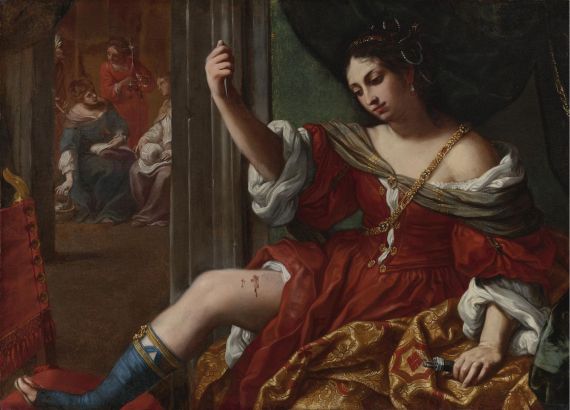 |
| Portia Wounding Her Thigh, Elisabetta Sirani, 1664 |
During the 19th century, women began to use a more creative way to illustrate artwork. They began to sculpt, photograph and quilt. Harris Hosmer was known for being the first professional woman sculptor. She was an American sculptor, who traveled to Italy to share the idea of neoclassicism. Her famous marble sculpture is Zenobia in Chains. Zenobia is in a drape and is putting all of her weight on one leg which gives the illusion that she is moving or walking. It symbolizes struggling women in a patriarchal society. Women grew an interest in learning photography. Photography was something new to women that they were trying to expose themselves to.
 |
| Harriet Hosmer, "Zenobia in Chains", 1859 |
Women were trying to prove themselves through their artwork. The technology was starting to develop and helped women take charge of their rights. This allowed Harriet Powers to become known. Her artwork was not meant to be displayed as art but as a means to support her family after her husband passed away. With her craftsmanship and creativity, she was able to quilt and use needlework. She was illiterate but was able to memorize stories from the bible and create quilts.
 |
| Harriet Powers, Pictorial Quilt, 1895 |
The lives of women changed throughout the Middle Ages to the 19th century. The strive for women wanting equality became evident. There is still divided between men and women in the art industry, but the roles have changed. Women are now able to express themselves and are not forced to hide behind men throughout history. Artists were able to become recognized and celebrated for their accomplishments. There will always be a struggle against women to feel fully free but much more progress to be made.
Work Cited:
The Guerrilla Girls’ Bedside Companion of the History of Western Art, Penguin Books, 1998.
Chadwick, Whitney. “Women, Art, And Society,” Fourth Edition. World of Art. 2007.
Subscribe to:
Comments (Atom)