Tuesday, May 5, 2020

Faith E. Layer

Post #5

May 5th, 2020


Race is a conversation that a lot of people tend to shy away from and as black women, these 5 artists make it their mission to emphasize the importance of having these conversations and recognizing our past and our future. Mickalene Thomas focused on beauty and female empowerment & Toyin Ojih Odutola's work as an artist reminds of of this book called The History of White people which examines the origin of race and where in history did we start to identify by skin. Faith Ringold, Kara Walker, and Abigail Deville focus on our past and what we can learn from it today. Women artist in general face struggles in art, but black women tend to be the least recognized and put in exhibitions.


Faith Ringgold The Flag Is Bleeding #2 1997


Faith Ringold: Injustice


Faith Ringold is an artist whos work depicts the hardships African-Americans deal with today and in the past. She is a civil rights activist, political painter, sculpter, and performance artist. She combines African heritage through her creation of story telling quilts to emphasize the racial prejudice and African American perception of whites present day and in the 1960s. Faith Ringold emphasises in The Flag Is Bleeding #2 that “she and millions off other Americans have direct lineage back to slavery” and this is something that we have to ackowledge, the past still continues to affect the future and that is what she exhibits in her art.


Kara Walker: Race


Kara Walker is an American Contemporary painter, but she is known for her room sized black cut silhouettes. Kara Walker: Virginia Lynch Mob and Other works explorers the history of race, gender, sexuality and violence

in the South. This piece depicts a group of people on their way to a lynching. The exhibition is accompanied with other pieces that show images of sexual encounters in the south at this time and Kara Walker Virginia Lynch Mob, 1998


the vulnerability of black women. Kara


Walker chooses this subject to emphasize the relevance of the past and the importance of remembering that history.


Mickalene Thomas: Black Beauty (Body, Sexuality)


Mickalene Thomas is an African American contemporary African from Jersey. She works with rhinestones and vibrant colors to create large and eye catch portraits. Seeing yourself and for others to see you. Women are shown as glamorous and assured subjects, which related to Thomas's mother and her personality. She started to think about women like her mother and used her as an inspiration to celebrate black femininity and sexuality by claiming feminine space in art and expressing women in this confident manner. She looked at art history and famous paintings of women and through that, Thomas visualized those older artworks and she positioned the women in her work just like them. Thomas made a contemporary version of these historical paintings that represented female sexuality, beauty, and power. All of this is done through multiple mediums and sizes of paintings, collages, photography, video, and installations.


Mickalene Thomas Afro Goddess Looking Forward, 2015


Toyin Ojih Odutola: Blackness (Body)


Odutola is a contemporary artist who focuses on the “socio political construct of skin color.” Odutola is Nigerian born, but grew in in Alabama. She emphasizes blackness in her art and the idea that what we think is not the reality of what it is. All of her figures appear to be black because they are all draw in black ballpoint pen, however what we see is an all black painting but our view of the actual figure is obstructed by their skin color, so the viewer does not think their anything other than "black".


Toyin Ojih Odutola The Treatment 37, 2016


Abigail Deville: Injustice


Abigail DeVille Sarcophagus Blue, 2017


Deville is an Installation, Sculpture & Performance artist, Deville focuses on the history of racial violence, gentrification and lost history among-st blacks (whitewashed history). Deville uses discarded materials, to construct complex room installations unearthing the overlooked histories of Black Americans. She celebrates the bravery, and joy in black culture as well as the memorializing the suffering endured and embedded in African-Americans from slavery. She presents in her work the idea that we have to examine our own humanity, because things from the past clearly still reflect on today's society. Working with Charlotte Brathwaite in a performance sculpture installation, they did a remake of the Day The Earth stood still to emphasize the idea that we were on the brink of self destruction and it’s time that we see change is inevitable and needed.


https://jackshainman.com/artists/toyin_ojih_odutola


https://www.nytimes.com/2019/12/03/arts/faith-ringgold-art-basel-miami-beach.html


https://www.theartstory.org/artist/ringgold-faith/


https://www.faithringgold.com/about-faith/


https://www.mickalenethomas.com/


http://michelrein.com/en/artistes/expositions/12116/Abigail%20DeVille


https://www.montclairartmuseum.org/exhibition/kara-walker-virginias-lynch-mob-and-other-works


https://art21.org/watch/new-york-close-up/abigail-deville-listens-to-history/


https://art21.org/gallery/abigail-deville-artwork-survey-2/#29

Monday, April 27, 2020

Post #5


Ronald Solano

Art and Women

April 27, 2020

Post #5

There is a common representation of nature through women’s work from modern and contemporary art. There is an irrefutable connection between the woman and their body being represented as nature, women being born to this idea that they are nurturers, soft, and caring. Women are often identified as givers of life or “seed” ready to sprout new life, while the idea of objectifying women and telling them that their sole purpose is to give birth is horrifying, I believe there is some capacity to transform these believes to something more realistic. This idea of women being like nature has been explored in art a million times and to this day are still being used, I am not discrediting these women’s work, I just think of how the women could relate their art to the land returning back to its roots right now. There are signs of life like animals roaming the empty streets, this idea of nature claiming its territory back resembles the growth of women’s rights over the years and their exploration in art.

Nature is even given female pronouns, this idea of woman being so raw and of the earth is what I feel is explored to some capacity by these artists. I see Helen Frankenthaler, Sandra Ramos, Monica Giron, Lee Krasner and Louise Bourgeois who are connected in their varying displays of nature and women. Each of these women explore nature in their work in various manners, some of them with color tones relating to the earth and others with gestural qualities that represent the earths movement and the movement of life.


Helen Frankenthaler, a leading abstract expressionist artist has work that exemplifies how nature can be seen through an abstract lens. Frankenthaler’s work of nature can be seen in her color tones and gestures. There’s a very earthly quality to her work, the waves of color in her work resembles the striations of layering in rock formations and waves from the ocean. Her singular abstract forms in her work almost look like they could take the shape of water.


Lee Krasner’s work has to be one of my favorites, I personally prefer her work over her husband’s. Krasner’s work has this very dynamic quality and grunginess that I love, her forms seem almost structural and some of the forms in her work almost look like people. There are some hints of what seem like cubism in her work, but her work feels very lively. There is a feeling of action in her work, some of her work which include more reddish colors almost look like flowers. Flowers are often used to represent potency and birth in art but what I love about how these “flowery” forms are depicted in Krasner’s work is that they are very rugged and very much sharp and fluid. These forms come off as very fast and non-welcoming, these flowers are independent from any typical dominant beliefs of the nature of flowers, these flowers are not meant to be seen as beautiful but rather to ward you off.


Monica Giron’s work is very different from the other approaches of nature, some of Giron’s work has what looks like birds. Her other work also has some semblance of nature which seems to be very visible but also a bit confusing, like her work “Llegada”. In this work we see various similar forms all centering around what looks like a frozen peak of ice, everything surrounding it seems like rocky mountain tops. The representation of multiple sides to the mountain is very apparent, it’s almost like there is a narrative of how life can be multifaceted and looking at the struggles of life and tribulations. Eventually you will get to the “top” or where one peaks, this is further enhanced by the title “Llegada” which roughly translate to arrival. There is beauty in how Giron displays this journey through nature and its creations.

Louise Bourgeois take on nature takes the form of an insect, the spider. There is a common focus on spiders in Bourgeois’ work, she has one work that is titled “Mother” and this work is of a giant spider constructed through weaving. Bourgeois’ work explores the idea of maternity through spiders and how they carry their babies, the spider is what Bourgeois’ identifies with this idea. What I like about her work out of all the other artists is that this approach is almost creepy-like, the idea of being a mother itself is terrifying to people, bringing in new life and having to take care of it on your own, but I believe there’s beauty in how large Bourgeois’ makes these sculptures of these spiders. Motherhood is something huge that people tend to discredit or sometimes claim over.

Sandra Ramos has a clear narrative in her work with its relation to nature. Her work clearly constructs the idea of how people believe women’s bodies are land that they can take claim over, this is represented through the actual display of land with women’s faces on the land. This is an actual clearer approach at the idea of nature which differs greatly from other artists like Krasner or Frankenthaler but overall has a message of how nature can be reproduced to mean different things.

Through modern and contemporary art there has been a clear shift in how ideas could be represented, they have been explored through natures lens. These women have represented nature in various forms, whether that be a clear representation of earth or abstracted through colors and gestures. Nonetheless, this work takes an even bigger meaning on when you think of its innate relation to women and societal beliefs. These women use nature to transform these ideas of women and how the world could be viewed. 

Chadwick, Whitney. Women, Art, and Society. Thames Hudson Ltd, 2020.
http://barro.cc/en/artists/10/monica-giron
https://www.nytimes.com/2019/08/29/arts/design/review-helen-frankenthaler-abstract-climates-provincetown.html?auth=login-email&login=email
https://i.pinimg.com/originals/99/3b/03/993b0352aab5a8949f8e7e8dfc328581.jpg
https://blog.artsper.com/en/a-closer-look/3826/
https://www.cubanartresources.org/sandra-ramos
La maldita circunstancia del agua por todas partes, 1993, Sandra Ramos


LLegada, 1991, Monica Giron


Flood, 1967, Helen Frankenthaler


Maman, Bronze, 1999, Louise Bourgeois 
Bird Talk, 1955, Lee Krasner

Five Women Artists

Andrea Oliva Dole
Art and Women
Post #5


Can you name 5 artists?


Women have been put down and for a long time not even treated as human beings. We live in a world where the patriarchy has taught us that we need to stand down and not speak up, that we are not worth it, and that we need to know our place. When it comes to art it was really hard to be recognized as an artist and it still is, because women are not often given the chance that we deserve

1.     Hannah Hoch: Gender Equality

Hannah Hoch was a feminist and a  pioneer of Dada but she didn’t get the recognition she deserved because of the men running the art scene. Hannah Hoch didn’t get the same opportunities as her male colleagues. “It was not very easy for a woman to impose herself as a modern artist in Germany… Most of our male colleagues continued for a long time to look upon us as charming and gifted amateurs, denying us implicitly any real professional status” (Guerilla Girls, 67). Hannah Hoch had to fight harder than her male colleagues to become a recognized dada artist and to have her work in museums. She was often fighting the machismo that was present in the art scene in Germany because men didn’t want to give her the place she deserved.

    Ohne TitelHannah Hoch 1930


2.     Kathe Kollwitz: Injustices           

Kathe Kollwitz is best known for her portrayal of war and poverty and injustices. If you look at her paintings you can see that she is painting people that are suffering from poverty, and the injustices that were happening back in the day, but we can relate this to today’s hardships due to the pandemic and the number of people suffering because they have no income and the government isn’t helping everybody. Kathe Kollwitz said, “I thought I was revolutionary and I [realized] I was revolutionary.” Women can be revolutionary, and Kathe Kollwitz was revolutionary and her art was political and it brought attention to the issues the country that people that had privilege were not paying attention to.

The People, Kathe Kollwitz, 1923

3.      Paula Modersohn-Becker: Female Body
Paula Modersohn-Becker was one of the first woman artists to paint the female nude form. Men have painted nudes for a long time but they are seen as something natural and it was seen as art. While men have painted the nude body for pleasure, women have painted with a different mindset, because we see our bodies as art. “Duncan’s essay points toward a long history in which the representation of the female body has been organized for male viewing pleasure”(Chadwick, pg. 280). We are aware of this because of the male gaze. Paula Modersohn-Becker takes the female body and turns it into something we want to look at not because of our pleasure but because it resonates with us.
Self-portrait on the 6th wedding anniversary, Paula Modersohn-Becker, 1906
4. Frida Kahlo:  Empowerment 
Frida Kahlo is the most famous artist of Mexico and with her art, she has inspired millions of people around the world. Frida Kahlo’s.  Due to all of her hardships, she became someone we could really relate to her and how she overcame all of these. Her story has helped others cope with loss and to be okay with who they are. When she was becoming a painter, she wasn’t taken seriously by her male colleagues. Frida Kahlo’s signature on her paintings which is her unibrow may have seen as someone who isn’t beautiful because facial hair has always been considered as a staple of beauty but she owned it and that is very empowering.

Henry Ford Hospital, Frida Kahlo, 1932


5. Judith Chicago: Feminist 
Judith Chicago is a feminist artist who has been bringing awareness to women’s issues since she began her career as an artist. She is best known for her creation of the “The Dinner Party” which is in the Brooklyn Museum. The Dinner Party is a table set up with plates dedicated to women in history and this is a great message because every woman should have a plate at the table. This is very symbolical because each plate has women’s genitalia painted on it and of course, it makes some people feel uncomfortable but women have been made to feel uncomfortable their whole lives. Judy Chicago has been fighting for women’s rights since the 1960s through her art and she is still doing it at the age of 80.
The Dinner Party, Judy Chicago, 1974-1979

References: 


Sunday, April 26, 2020

5 Women Artists

Women Empowerment/Strength 

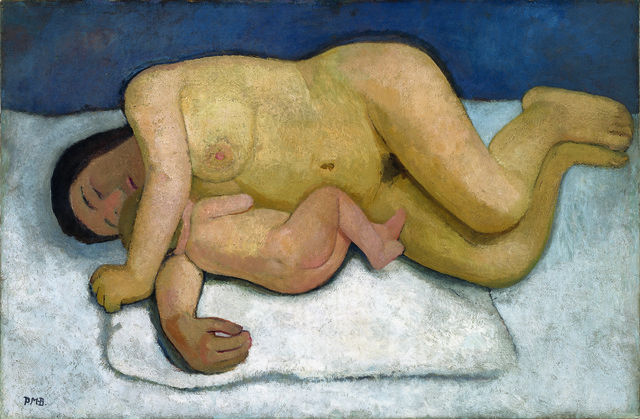
Paula Modersohn-Becker was a German painter. She was recognized as one of the first known female painter to paint nude self-portraits. Her life was cut short at the age of 31 when she died due to a postpartum embolism. During her time as a female artist she focused on landscapes, still life’s and domestic scenes. She drew the attention towards women and girls. In her art pieces she drew upon motherhood/maternity, infants, young girls and old women. Up until Paula Modershon-Becker began her art career, the use of nude females as subjects were not common and not something the attention shined upon. Becker’s work on the female nude expresses an ambivalence to both her subject matter and the method of its representation. In her art piece titled Mother and Child Lying Nude, which was published in 1907 portrays this strong feminine/motherhood role. A mother can be seen cuddled and cozy next to an infant. The infant is nuzzled into the mother’s body seeking to be nurtured. From a quick glance, it looks like the mother is breastfeeding her child which goes to show how powerful a women’s body is. To produce and grow life and to be able to nurture/feed/support an infant once it is born shows how incredible a women’s body really is. Her nude body clearly depicting the imperfections of a women’s body post-partum, but yet the subtleness and beauty of the creation of life in the infant.

Paula Modersohn-Becker, Mother and Child Lying Nude, 1907 
Frida Kahlo was a Mexican female artist during the 19th century. She was considered one of Mexico’s greatest artists who was well known for mainly her self-portraits. Frida Kahlo was inspired by the county’s popular culture which she seeked to explore identity, post-colonialism, gender, class and race in the Mexican society. A distinguishing feature Frida Kahlo was known for was her unibrow. Her unibrow was important because it curved from the meaning/stereotype of what a woman should look like. She wanted to steer away from the stereotypes of what was and wasn’t attractive. The purpose of her unibrow look was to shed light for women who feel dictated or shamed by narrow social constructs of what was considered “normal”. In this particular piece titled My Birth by Frida Kahlo, it is the perfect descriptions of a women’s strength and body. In the art piece it shows a women going through childbirth and bringing a Childbirth is something painful but yet beautiful. It shows how powerful a women is to go through something so painful but yet so beautiful for not only one day but over a course of 9 months.
My Birth, 1932 by Frida Kahlo
Frida Kahlo, My Birth, 1932
Pan Yuliang was a well known Chinese female painter. She was well known for her self-portraits and female nudes. Pan focuses mainly on the female nude as her subject in most of her paintings to depict the vitality, beauty and maternity of women. During her time, the use of nude figure paintings were looked down upon and seen as vulgar and cheap, but that never stopped her. Her use of self portraits were meant to be viewed as her expression and her inner feelings that yearned for family, and depicted her sorrow and loneliness. In Yuliangs panting titled Nude Study, she is clearly depicting the beauty and depth of a women’s body. The nude female figure has become the subject of the painting. The painting gracefully embraces the females curves, her breasts and the imperfections that make a women who she really is.
Art and Women Spring 2015: Post 3Art and Women Spring 2015: Post 3
Pan Yuliang, Nude Study, 1947 

Shirin Neshat is a female Iranian visual artist who is based in New York City. She is mainly known for her subjects and focus in Islam, femininity, masculinity, modernity and so forth. She is well known for her work in photography, video and film. She explores the relationship between women and the Islamic religion and the cultural values/system of Islam. Her work focuses on both the private and public life of a s Muslim women. In this piece titled Rebellious Silence by Shirin Neshat is a photograph apart of her “Woman of Allah” series. The photograph is a portrait along a vertical seam by the long barrel of a rifle. The rifle rises in the picture, grazing her face at the lips, nose and forehead, leaving her eyes starring intensely towards the viewer from both sides of the barrels rifle barrel. Her series “Woman of Allah” examines the complexities of women’s identity through its culture/religion. A Muslim woman of the Middle East is a more intimate subject that speaks words and volume as to what she stands for. The Arabic text over her face serves as a veil – to lower the male gaze and prevent her from becoming sexualized. A women’s body is constantly portrayed as objects of desire and available to be looked at without consequences and her use of the Arabic writing is meant to steer away the male gaze considering it is a sin in the Islamic culture.
Shirin Neshat - Signs: Journal of Women in Culture and Society
Shirin Neshat, Rebellious Silent, 1994
Michele Pred is a Swedish-American female artist. Through her work, Pred focuses the main idea of the piece towards cultural and political issues such as equal pay, reproductive rights, personal security and other issues that women continue to face. Each of her work speaks volume and has such a deeper meaning to it all. An example would be her fight for reproductive right in which she has used expired birth control pills, and the use of vintage handbags to describe the continuing economic and political struggle for women's right. In her 2019 piece titled “Power of the Purse” she portrays a display of multiple purses which contain powerful statements directing towards women’s rights such as, “me too”, “pussy grabs back”, “equal pay”, “pro choice” and so forth. All her pieces continue to show her fight for women’s right and women’s empowerment.
Michele Pred
Michele Pred, Power of the Purses, 2019


Works Cited:
https://www.dailyartmagazine.com/paula-modersohn-becker-mother-and-child/
https://www.biography.com/artist/frida-kahlo
https://www.widewalls.ch/artist/pan-yuliang/
https://www.khanacademy.org/humanities/ap-art-history/global-contemporary-apah/20th-century-apah/a/neshat-rebellious
https://michelepred.com/section/315880_Power_of_the_Purse.html

Five Woman

Black Women Empowerment
Through the decades, black women have used art to capture the joy, pain, and glory of black culture and other things. I have learned that woman artists have come a long way from the Middle Ages and the Renaissance. I have also learned how women have expressed their frustrations, rebellions, and emotions through art when the patriarchal society silenced them. I would like to focus on the theme of the black woman race. Even when society started to become more liberal and accepting of women artists, black women were still the minority. For example, someone like Harriet Powers had to create her beautiful Bible Quilt in secret. Within the Quit expressed gems for freedom that she yearned for. Fast forward hundreds of years later, we now are able to see a black woman as America’s first lady, Michelle Obama. As art has moved to cubism and modernism, it made a way for these women artists that I am going to talk about to express their "self - conscious set of practices and characteristics through which modern art is understood". (Chadwich, 279). All the artwork that I have attached relates to women empowerment and the desire of pouring the black race and history into society and all parts of the world through art.

Amy Sherald is a contemporary African - American painter who is known for her portraits that address issues of injustice in black culture. Sherald’s style of painting skin tones in gray helps to break society from judging individuals based on their skin tone. She states that she wants people to imagine life outside of the “circumscribed stereotype, or identity that can be controlled by many circumstances such as their environment”.  After living in Baltimore, she was inspired to paint about poverty in African American society. She continues to live and paint in Baltimore, where she creates a plethora of influence through her paintings. Amy is known for her famous painting of Michelle Obama, which would change the art industry forever. This painting of Michelle Obama stood for the representation for the black woman artist to come and it stood for all the black women who are not represented in the mass media and entertainment industry. As Michelle Obama states herself in her painting “ Mrs. Obama commented on the lack of black women in portraiture and shared her hope that Sherald’s portrait would inspire younger generations. Mrs. Obama said, ‘I’m also thinking about all of the young people, particularly girls and girls of color, who in years ahead will come to this place and they will look up and they will see an image of someone who looks like them hanging on the wall of this great American institution.” Learning about women in art from the Middle Ages until this modernism period has been huge enlightenment for me. Especially seeing women like Amy being able to paint First Lady Michelle Obama through her own radical style of grey skin is incredible. Granted there are still issues in women of color in that industry but to see this advancement and improvement is outrageous. It surely is a big movement for all people in the black community. 
Amy Sherald, Michelle LaVaughn Robinson Obama, 2018. National Portrait Gallery, Smithsonian Institution. Courtesy the artist, Monique Meloche Gallery, Chicago, and Hauser & Wirth.

Lorna Simpson is an African - American photographer and multimedia artist who is mainly known for her conceptual black and white photos. Lorna Simpson explores the experience of African American women in contemporary society. Simpson re-remains photography as conceptual art. Her images are specifically selected from original photos from eBay and flea markets. Simpson likes to show her subjects from the back, instead of depicting them from the front. She also liked to show them from behind with their faces and eyes “obscured” or “omitted”. This allows her to emphasize the social and political implications of the African textures and hairstyles. Simpsons' work is often shown as open-ended or fragmented. Simpson states that her work “ seeks to explicate the ways in which race and gender shape human interactions, specifically in the United States, through the medium of portraiture”. In her famous work “Stereotypes” she was able to portray how the identity is “externally projected”. Lorna does not just capture photos but uses them in an essential way that is able to help society be more open-minded about African - American women. 
Simpson, Lily.” Stereo Styles [Styles stéréo]”. 1988. Collection of Melva Bucksbaum and Raymond Learsy

Faith Ringgold is a painter, civil rights activist, author, and more. She is best known for her narrative quilts. Faith was born during the Harlem Renaissance. Faith is a renaissance woman who was able to first-hand experience art during her time until the art in this day and age. The woman portrays an African American woman who is looking at herself in the mirror. The African American woman cries as she looks at herself in the mirror because she does not see the woman that society wants her to be. The controversy of who the woman sees in the mirror, speaks to the multifaceted nature of her identity. The painting challenges the visual history of women and mirrors in Western Art. Faith’s artwork always communicates to her political beliefs. Her inspiration stems from James Baldwin, Amiri Baraka, Impressionism, and Cubism. Ringgold’s paintings received a lot of attention, but at the same time, she received backlash due to her works being focused on the underlying racism in everyday activities. Her themes became “normal” during the Civil Rights Movement and the Women’s movement.
Fig. 2. Faith Ringgold, American People Series #16: Woman Looking in a Mirror, 1966. Oil on canvas, 33 x 32 in. Courtesy the artist, Pippy Houldsworth Gallery, London and ACA Galleries, New York; photography by Benjamin Westoby. https://editions.lib.umn.edu/panorama/article/faith-ringgold/
Kara Elizabeth Walker is known for her conceptual art, multimedia art, text, painting, printmaking, and her collages. She was born on November 26, 1969, in Stockton, CA. Walker explores race, gender, sexuality, violence, and identity in her work. She is best known for her large- scale tableaux of collaged silhouettes among black-and-white pastoral landscapes. Walker often provocatively illustrates slavery in the antebellum South. Walker wants her work to do more than impress the viewer. Walker states that she wants the viewer to get pulled into history, giggle nervously a little, never walk away, pulled into fiction, something “ demeaning and something very beautiful” then something beautiful and creative. Kara’s work illustrates racial stereotypes of the past and present. What I extremely love about Kara’s work is not only does it address slavery and racial discrimination but it also raises awareness of the bigotry that still exists in the United States.

Walker, Kara. Resurrection Story Without Patrons, 2017 Etching with aquatint, sugar-lift, spit-bite and dry-point on paper

39 3/4 × 49 in
101 × 124.5 cm
Augusta Savage's career was elevated during the Harlem Renaissance. In the 1930’s she was well known as a sculptor, art teacher, and community art program director. Her career almost collapsed during the Great Depression, however, she endured and became the first African-American artist to be elected to the National Association of Women Painters and Sculptors. She launched her own “Savage Studio of Arts and Crafts” located in Harlem. She was one of four women to receive a professional commission from the Board of Design of the 1939 New York World Fair. She created life Every Voice and Sing “ The Harp”.  Much of her work is clay or plaster because she could not afford bronze. Her work is currently displayed in Washington, D.C in the Cleveland Museum of Art. Her sculptors bring awareness and significance to African American history. Her sculptors have the ability to capture pure emotions in expressions and poses of their subjects. Savage symbolizes the power and strength of African Woman, she was denied from art schools in Europe, she received the commission from W.E.B Dubois and received a scholarship for art school in Paris. Savage told the Black Women to America, 1982 that her goal was to teach and inspire “youngsters to develop the talent they know that I possess, then my monument will be in their work”.
Augusta Savage, Civil Rights Sculptor. Courtesy Federal Art Project, Photographic Division collection, 1935-1942. Archives of American Art, Smithsonian Institution. https://americanart.si.edu/artist/augusta-savage-4269

Work Cited
https://www.artsy.net/artist/lorna-simpson
https://editions.lib.umn.edu/panorama/article/faith-ringgold/
http://www.artnet.com/artists/kara-walker/
https://americanart.si.edu/artist/augusta-savage-4269
Chadwick, Whitney. Women, Art, and Society. Thames Hudson Ltd, 2020.